When your AI becomes a design partner, the design-team org chart collapses the same way the dev team's did.
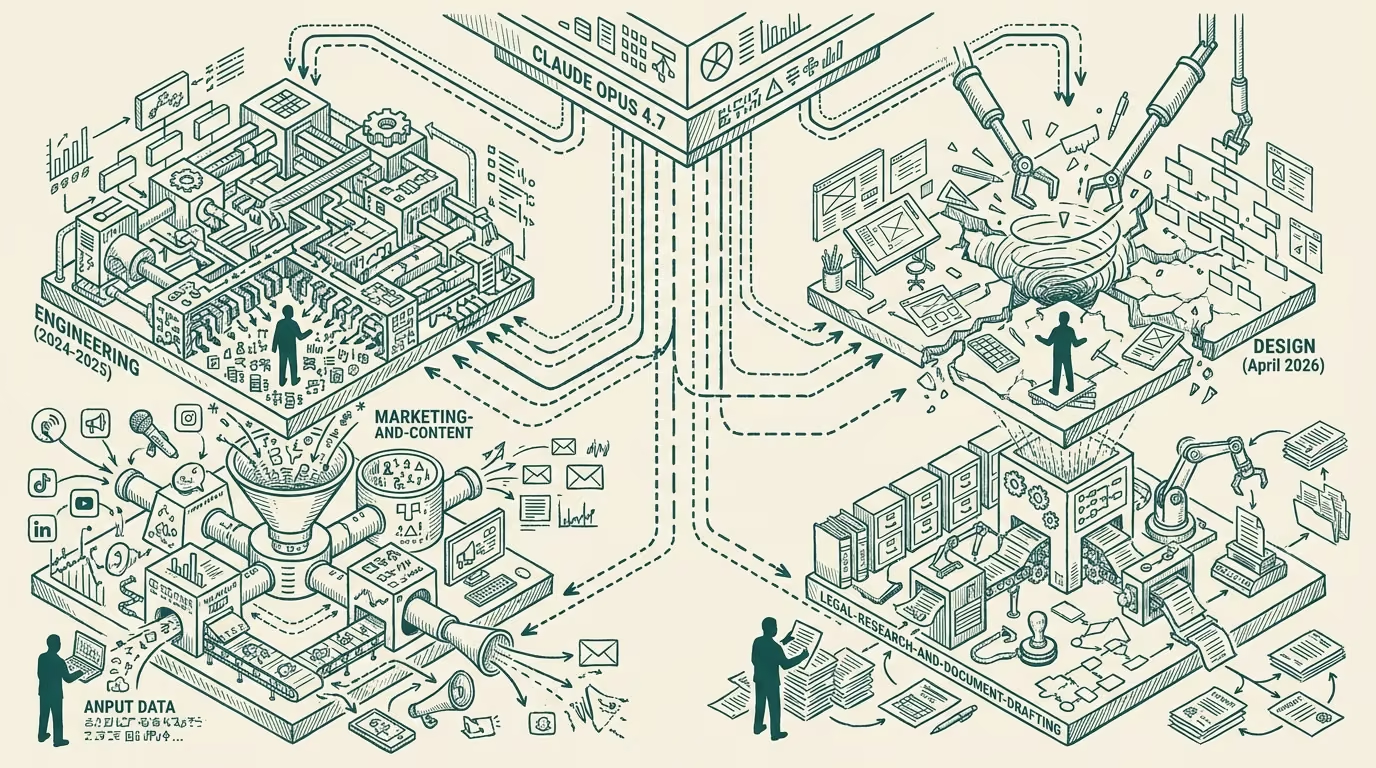
The April 2026 Claude Opus 4.7 release brought visual-AI capability into the design-partner-class quality range, with the operator-class running design teams now facing the same compression the engineering org chart absorbed through 2024-2025. The pattern is recognizable to anyone who watched the engineering compression: the senior practitioner becomes substantially more productive, the mid-level practitioner sees their work substantially augmented, the junior-tier practitioner faces the structural reduction in the kind of work the team needs at their level.
The sequence of knowledge-work disciplines that compress under AI capability runs in a predictable order. Engineering went first because the input-and-output of engineering work (code, structured documentation, version-control trails) is well-formed for AI to operate against. Design is going now because the visual-AI capability has matured to the point that design tools-and-workflows produce the same kind of structured input-and-output the engineering work did. The teams that go next are the ones whose input-and-output structure the AI capability can operate against at the same level.
The candidates for the next compression-cycle are recognizable. Marketing-and-content production is a strong candidate because the input-and-output is text-and-image-heavy, which the current frontier-AI capability handles well. Legal-research-and-document-drafting is a strong candidate because the input-and-output is well-structured legal-class documents, with the regulatory-and-clinical complexity being substantial but tractable. Financial-modeling-and-analysis is a strong candidate because the input-and-output is structured numeric-and-text data with established analytical conventions. Each of these knowledge-work categories is positioned for the compression cycle on a 12-24 month timeline.
The pattern that the engineering and design compression-cycles produced is worth naming for the next cohort of categories. The senior-tier practitioners benefit substantially from the AI augmentation, with their productivity multiplying and their compensation generally increasing alongside it. The mid-tier practitioners face mixed outcomes, with the most adaptable absorbing the augmentation as a productivity multiplier and the less-adaptable facing structural displacement. The junior-tier practitioners face the largest impact because the work that previously trained them into the senior-tier roles is the work that AI now does, with the consequence that the apprentice-class career path through the discipline is meaningfully disrupted.
The implication for organizations running these knowledge-work categories is that the org-chart structure that worked through 2020-2024 is not going to work through 2025-2028. The flat-pyramid structure that knowledge-work organizations have been running, with substantial junior-tier headcount supporting the senior-tier work, becomes a steep-pyramid structure with smaller junior-tier and larger senior-tier headcount. The transition produces operational and personnel-class friction that the prior generation of knowledge-work disciplines (engineering, design) is in the middle of working through.
For knowledge-workers in the categories not yet at the compression cycle, the practical advice is to develop the senior-tier judgment-and-context capabilities that the AI augmentation cannot easily substitute for, while also developing fluency with the AI capability that the augmentation requires. The combination produces a position that survives the compression cycle. Workers who develop neither face structural displacement on the cycle's timeline.
The org-chart collapse that happened to engineering, that is happening to design, will happen to the next discipline-class on its own timeline. The pattern is durable. The operator-class running these organizations should be planning against the pattern rather than against the assumption that the pattern stops at the disciplines already affected. It does not stop. It continues. The next cohort of categories will absorb the compression, and the durable read should be calibrated for that trajectory.
—TJ