Alberta restructured its health system while talking about AI. The restructuring is the story.
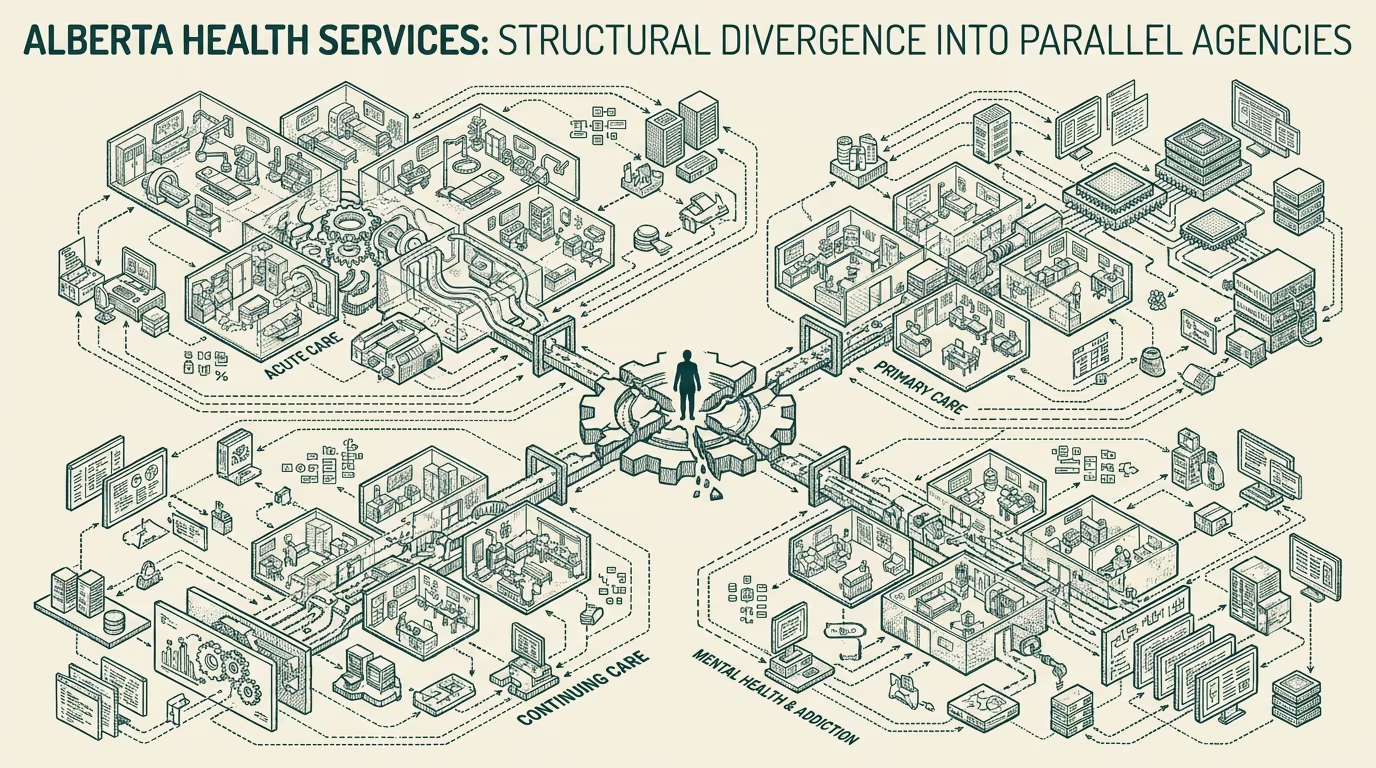
Alberta's May-June 2024 health-system restructuring broke Alberta Health Services, the unified provincial health authority that had operated since 2008, into four sector-specific agencies covering acute care, primary care, continuing care, and mental-health-and-addiction. The restructuring was accompanied by substantial public commentary from the provincial government about AI-driven efficiency, modernization, and the broader theme of healthcare-system improvement through technology investment. The AI commentary was the visible surface. The org-structure change was the actual operational signal that matters for the operator class working in the Canadian provincial healthcare environment.
The pattern of governments talking about AI while doing structural change is recognizable across multiple provincial-and-federal contexts. The AI commentary functions as political cover for the harder organizational work, with the AI being a press-friendly framing that reduces the political cost of the org-change. The structural change is the durable operational consequence that affects how the system actually runs.
For Alberta operators, the four-agency structure produces several specific consequences that the AI commentary does not address.
The procurement-and-vendor-relationship environment changes. Vendors who had a single-buyer relationship with AHS now face four buyers with potentially different procurement processes, technology preferences, and vendor-evaluation frameworks. The vendor that had a province-wide relationship needs to rebuild it across the four agencies, with the rebuilding work being substantial and producing winners-and-losers in the vendor population.
The data-portability-and-interoperability environment changes. The four agencies will, over time, develop their own data systems, integration patterns, and clinical-information infrastructure. The patient who moves across the agencies (a patient receiving acute care plus mental-health support, for example) will face the data-portability problem the four-agency structure produces. The infrastructure work to address the data-portability gap is meaningful and the political-or-funding mechanism to do the work is not yet in place.
The accountability-and-performance-measurement environment changes. The single AHS authority had a single set of performance metrics and a single accountability structure. The four-agency system has four accountability structures, with the cross-agency outcomes (the patient experience that spans multiple agencies) being structurally harder to measure and to assign accountability for. The political-class will eventually need to address the cross-agency accountability question, and the answer will shape provincial-level decisions about funding, technology investment, and structural-change-cycles in subsequent years.
The combined effect is that Alberta in 2026-2028 will have a structurally different healthcare system from Alberta in 2022-2024, with the difference being substantially more durable than any AI deployment the system runs through the same period. Operators positioning their products and services for the Alberta market need to read the four-agency structure as the central operational reality, with the AI work being the secondary feature that adapts to the structural reality rather than the central driver of strategic decisions.
The pattern generalizes. Governments talking about AI while doing structural change are signaling that the structural change is the operational reality. Operators who read the AI commentary as the signal will mis-allocate strategic resources. Operators who read the structural change as the signal will allocate correctly.
Alberta restructured. The AI conversation was the noise. The four-agency structure is the signal. The next several years of Alberta-market operational work will run against the four-agency structure rather than against the AI deployments the public commentary has been highlighting. Build for the structure. The AI is the secondary feature.
—TJ