Aschenbrenner cuts both ways now.
Leopold Aschenbrenner's "Situational Awareness" landed in June 2024 with a 165-page argument that AGI was arriving by 2027 and a national-security-class strategic recommendation set followed from the calendar. The trade press read it as a forecast. The venture press read it as a thesis. By late 2025, the essay had become something operationally sharper than either reading.
What's the essay actually doing in late 2025?
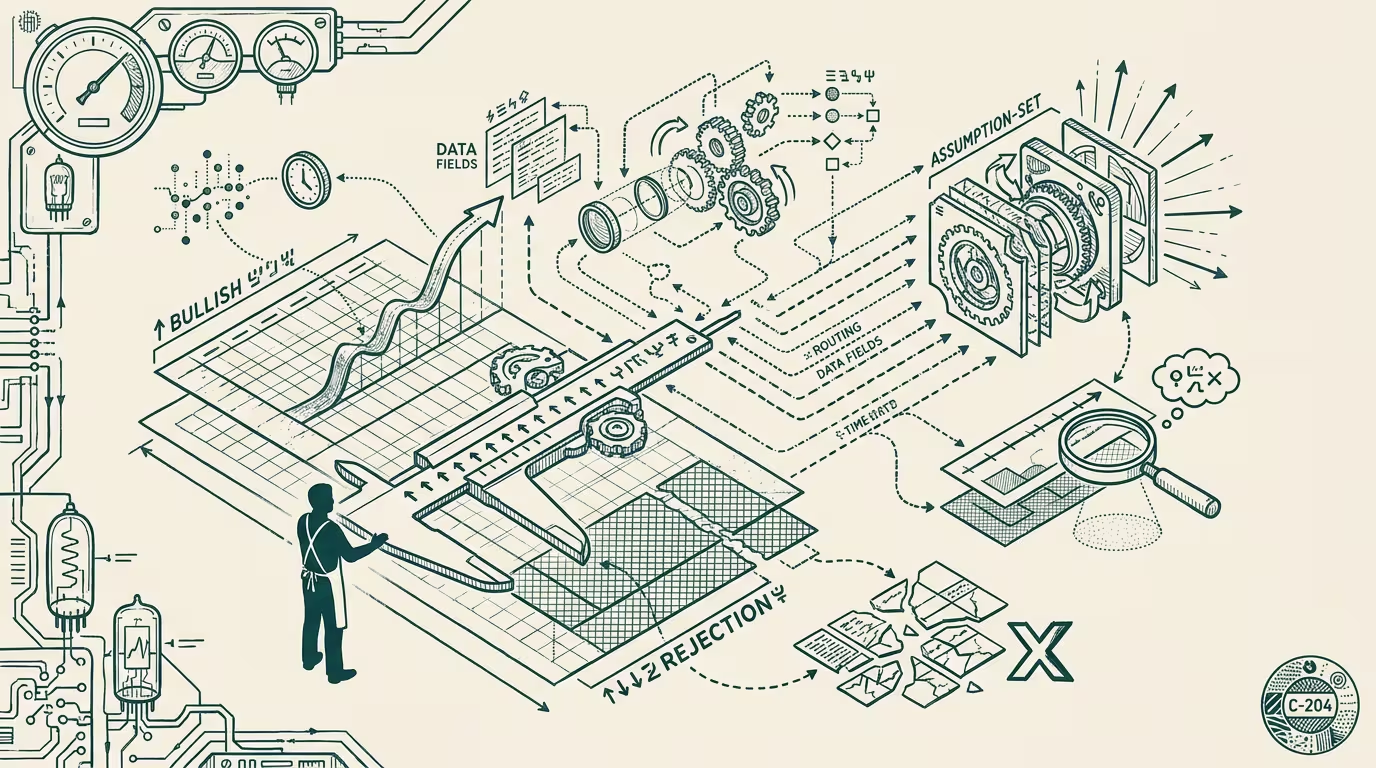
It's a calibration check. If your 2026 AI plan reads consistent with Aschenbrenner's calendar — aggressive talent pull, infrastructure procurement locked-in-now, position-staking on agent-runtime architectures that survive the 2027 capability shift — you are either bullish-aligned or unaware. If your plan reads against the calendar, you have to say which assumption you are rejecting. _Either way, the essay forces the assumption-set into daylight._ That is the operator-class function it serves in late 2025 and 2026, regardless of whether the timeline holds.
Why is the calibration function durable? Because it works independent of forecast accuracy. Aschenbrenner could be right, half-right, or wrong on the timeline; the essay still does the work of forcing every operator-grade plan to take a position on the calendar. The discipline is in the forcing, not in the answer. Operators who read the essay and run their plan through it are operating with cleaner assumption-sets than operators who don't. The cleaner assumption-set is the operating advantage, not the calendar.
What's the load-bearing artifact the essay produces? The assumption-set it surfaces. The essay names assumptions about chip supply, compute scaling, coordination capacity, talent migration, and policy response. Each assumption is challengeable on its own merits. Operators rejecting the calendar should be rejecting specific assumptions in specific places, not the calendar wholesale. The granular rejection is operating-relevant. The wholesale rejection is, in 2026, the position of operators who haven't read the essay.
How does the essay's effect run by late 2025? Both directions. Bull-aligned operators cite Aschenbrenner to defend aggressive 2025-2026 capital deployments. Bear-aligned operators cite Aschenbrenner to surface the assumption-rejection that justifies their conservative deployment posture. Both operators are using the essay correctly. The essay's work is complete in either case. The trade-press framing of "Aschenbrenner is bullish" misses the structural shift, which is that the essay has become the assumption-surfacing artifact that both bull and bear plans now reference.
The same shape recurs across categories. In healthcare-AI, "AI as Normal Technology" and "Machines of Loving Grace" play a similar bidirectional calibration role. In travel, the AI-displacement-of-search-traffic forecasts play the role. Each category has its own calibration document; the operator discipline is to use it for assumption-surfacing rather than to read it as a forecast.
What survives all of this is that "Situational Awareness" is one of the more consequential AI-strategic-planning documents of the 2024-2026 cycle because it forces the assumption-set into daylight, the trade-press treatment of it as a bull-thesis missed the structural function, and the operator-grade discipline is to use it as a calibration check on every 2026 AI plan written. By 2027 either Aschenbrenner is right and the bull-aligned operators win, or he is wrong and the bear-aligned operators win, or the timeline lands somewhere in between and the operators with the cleanest assumption-rejections win regardless.
Aschenbrenner cuts both ways now. The essay's calendar is contested. The assumption-set it surfaces is the operator artifact that survives whichever way the calendar resolves. Operators using it that way are operating coherently in either direction. Operators using it as a bull-thesis or as a bear-rejection wholesale are not.
—TJ