The clinical-decision-support liability question.
The legal question has a boring answer and an interesting answer.
The boring answer is that, almost everywhere in the United States, when an AI clinical-decision-support tool produces a recommendation that a physician follows and the patient is harmed, the liability lands on the physician. The doctrine that does the work is the _learned intermediary_: the human clinician sits between the tool and the patient, and the law assumes the clinician exercises independent judgment about whether to follow the tool. This is a settled doctrine in adjacent areas (drug labeling, medical-device warnings) and the courts are extending it to AI advisory systems with very little resistance. By the end of 2025 there will be a handful of named cases on the public record. None of them will produce surprising rulings.
The interesting question is what changes operationally now that the question has a settled answer. Five notes.
The settled answer makes adoption faster, not slower. The hospital-system general counsel that has been waiting for liability clarity before greenlighting a CDS deployment now has it. The clarity is not friendly to the physician individually, but it is friendly to the institution, which is the buyer. Deployment timelines compress. The CDS vendors that spent 2022 and 2023 hedging their pitch around the liability question pivot to capability claims, because the question they were hedging on no longer needs hedging.
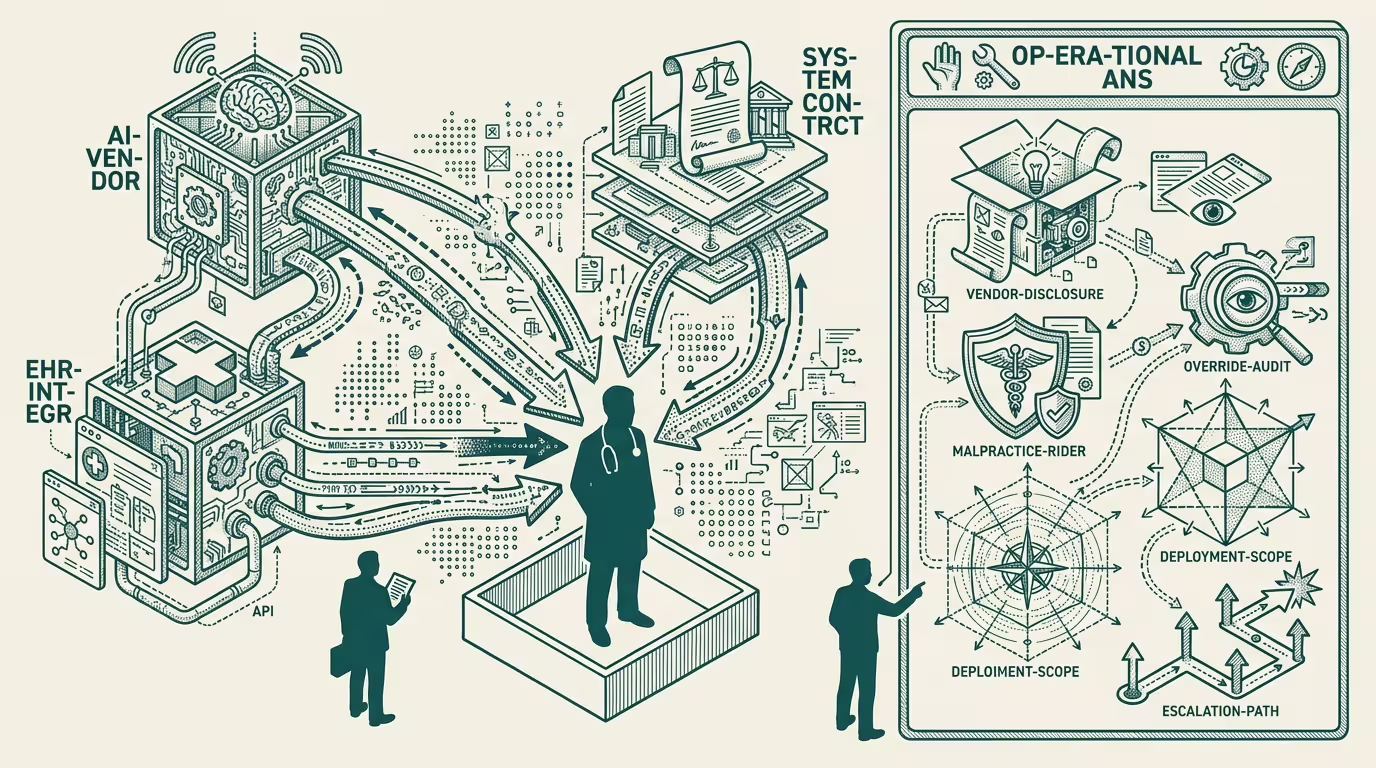
The physician's individual exposure is the actual lever. The physician carries the malpractice premium, and the malpractice carrier underwrites against the physician's documented decision pattern. CDS systems that produce auditable rationale traces, where every recommendation is tied to a citation and every override is logged with reasoning, become more attractive to the malpractice carrier than CDS systems that produce a confident-sounding sentence with nothing underneath. The carriers will, within two to three years, inevitably start pricing premiums on the auditability of the CDS stack. The systems that lose are the ones that look like a chat interface dressed up as a clinical tool. The systems that win are the ones that look like a structured workflow with rationale at every step.
Vendor liability is not zero, it is contractually bounded. The CDS vendor is shielded by the learned-intermediary doctrine _only_ against direct claims by the patient. It is not shielded against indemnification claims by the hospital, and the hospital contracts of 2024 and 2025 are starting to carry indemnification clauses that pull the vendor back into the chain. The vendor can refuse the clause, in which case the deployment does not happen; or it can accept a capped indemnification, in which case the cap becomes the operational ceiling on how much risk the vendor is willing to underwrite. Within twenty-four months the typical cap will be well-known and stable, and procurement teams will treat it the way they treat any other contractual lever. Vendors with the capital to underwrite higher caps will outcompete vendors that cannot.
The labeling and warning surface is doing more work than the algorithm. Physicians override CDS recommendations roughly forty to sixty percent of the time in the studies that have measured it, and the override rate is highly sensitive to how the recommendation is framed. A red-flag warning at the top of the screen produces a different override rate than the same content surfaced as a passive footnote. The framing decisions are made by the vendor's UX team, in many cases without input from the clinician audience the system is targeting. The malpractice case that lands first is going to turn on the framing, not the underlying model output, and the systems that did the framing carefully are going to look very different in court from the systems that shipped the engineer's first guess.
The interesting frontier is the no-physician case. Everything above assumes the learned intermediary is in the loop. The categories where the intermediary is being engineered out (direct-to-patient triage chatbots, automated radiology pre-reads that route around the radiologist, ambient-scribe systems that document encounters the physician never reviews in detail) are categories where the doctrine has nothing to grip.
The first generation of plaintiffs' lawyers who figure out which deployment categories have _removed_ the intermediary will find a much friendlier court than the ones suing through the intermediary. The CDS-adjacent deployments most exposed to this are also the ones most aggressively marketed on a labor-savings frame, which is the frame that produces the worst optics in front of a jury. The vendor that markets a tool on "saves the physician twenty minutes" is also the vendor whose marketing copy gets read aloud at trial.
It is worth slowing down for a paragraph on what the doctrine costs in practice. A patient harmed by a CDS recommendation that the physician followed will, in the standard case, have a path to recovery only against the physician. The CDS vendor walks away. The physician, who may have been working a sixteen-hour shift in a system that already underpays attention to documentation, will carry the malpractice case, the premium increase, and the shadow on a career that was difficult enough before the AI layer was added. The patient's family, in the standard case, will not have a path against the vendor whose tool produced the recommendation. The doctrine is settled. The cost of the doctrine being settled lands on the two parties the doctrine was supposed to protect, and the operational consequences described above are downstream of a structural choice that almost no one is examining out loud.
The summary is that the legal question has been answered, and the operational consequences are starting to compound.
The CDS vendors that win the next three years will be the ones with auditable rationale traces, well-priced indemnification caps, careful framing of the warning surface, and a clear refusal to deploy in categories where the intermediary has been engineered out. The CDS vendors that lose will look, in retrospect, like they confused a settled legal question with a settled operational one.
—TJ