Most enterprises can't build a clean thesis. Expedia builds 1,500 agents a year.
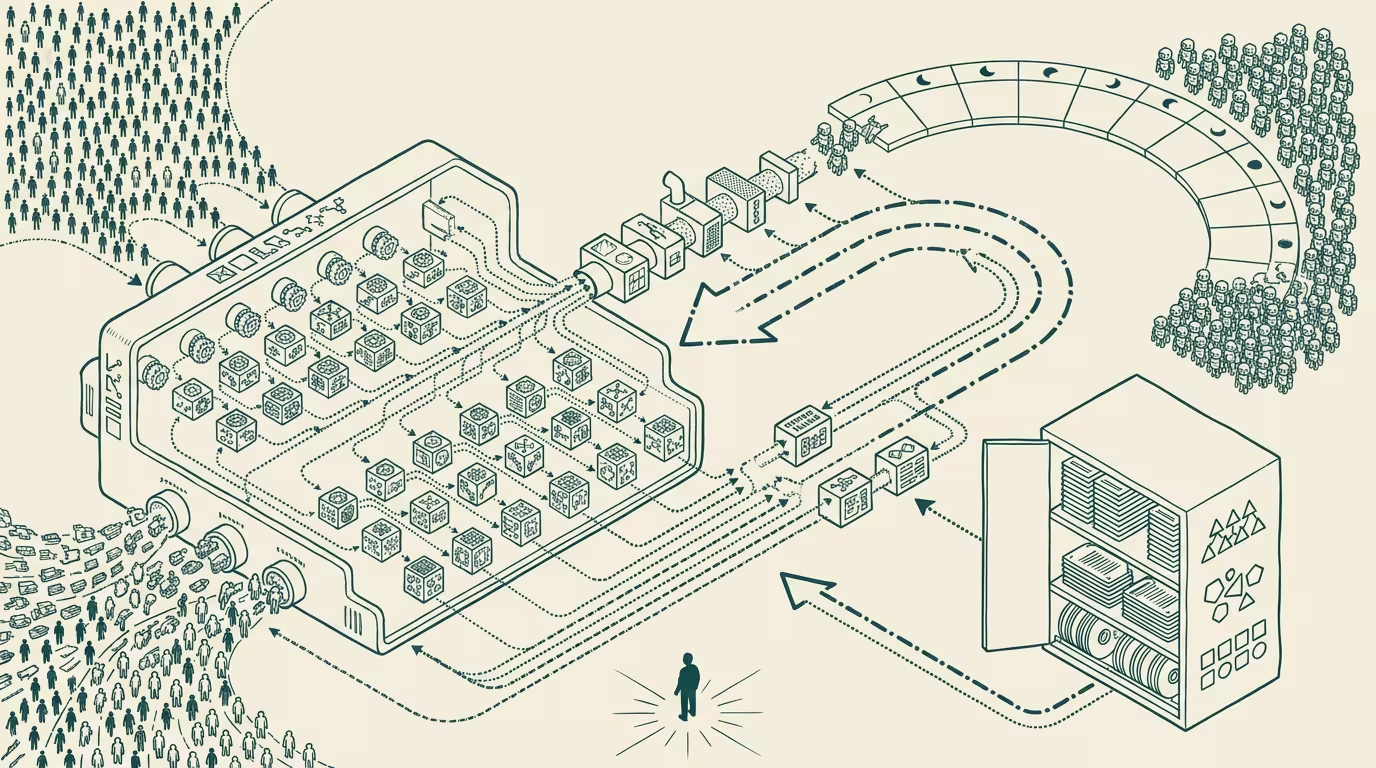
Expedia's CTO disclosed at a Q1 2026 industry briefing: 1,500 internal AI agents built in twelve months across 17,000 employees, handling 143 million customer conversations annually through the deployed agent class. The deployment ran on what Expedia calls the AI Playground — sandboxed enterprise access to 60+ frontier-and-open-source LLMs, with internal tooling for employees to build, test, and deploy agents against company data without engineering-class build-from-scratch overhead.
The trade press wrote it as "Expedia leans into AI." The durable read is sharper.
_The agents are the surface. The proprietary dataset of use-case discovery, failure modes, and productivity patterns is the moat._ Hold that frame in view. Everything that follows traces back to it.
The 1,500-agent number isn't the headline number that matters. The headline number is 60+ LLMs and 17,000 employees with sandboxed access. The structural advantage that compounds is the proprietary dataset that emerges from the deployment.
Trace the dataset back to its source and the moat sharpens. Expedia's AI Playground generates a kind of internal competitive intelligence no external vendor can replicate. Every agent built captures: which use cases the company-class workforce found valuable enough to pursue, which agent designs failed at production load, which workflow patterns yielded measurable productivity, which model choices produced what outcomes for which task types. The dataset is proprietary because no vendor can observe Expedia's internal workforce engagement at the granularity the playground captures. That dataset is operationally more valuable than any single agent the playground produces.
Trace it forward to the moat-depth comparison and the build-vs-buy distinction sharpens. A buy-from-vendor model captures vendor capability but doesn't generate proprietary deployment-pattern data. A build-capable enterprise model captures both capability AND the proprietary signal of which capabilities matter for which workflows. The latter is structurally more durable because the signal compounds across capability cycles. When the next-generation model arrives, the build-capable enterprise's existing playground patterns inform deployment of the new capability faster than competitors who are starting from vendor-mediated learning. Expedia's 1,500-agent base is not the moat; the deployment-pattern dataset is.
Trace it through to the workforce-knowledge layer and the retention consequence sharpens. Employees who build agents in the playground develop organizational knowledge about which workflows benefit from agent automation, which guardrails prevent failure modes, and which metric movements indicate productive deployment. That knowledge is operator-class infrastructure that compounds as employee tenure compounds. Switching costs from the playground are operationally high because the institutional knowledge is woven into the workforce's daily-deployment patterns. Expedia's playground produces high switching costs through workforce-knowledge accumulation, not through technology lock-in.
Trace it through to the competitive bifurcation and the structural inaccessibility surfaces. Companies with the engineering-class capacity to build and operate the playground (hyperscalers, frontier-tech enterprises, top-decile financial-services firms, engineering-led companies like Expedia) capture the moat-compounding deployment-pattern dataset. Companies without that capacity — most middle-market enterprises, regulated-industry incumbents with traditional IT structures, the long tail of organizations whose engineering function is integration-and-maintenance-class — cannot replicate the model. The competitive bifurcation between the two cohorts compounds through 2026-2028 as the build-capable cohort accumulates the deployment-pattern moat.
The same shape recurs across other build-capable enterprise AI deployments. Build-capable enterprise AI deployment is a moat-class category that few companies in regulated industries currently occupy. Expedia is one. JPMorgan is another. Microsoft, Google, Amazon are obviously category-defining. The list of companies operating at this layer is short. The list of companies that should be operating at this layer but aren't (because they lack the engineering-class capacity to build and maintain it) is longer. Operators in the latter category are operationally exposed to the buy-from-vendor model, which captures less moat-class value than the build-capable model.
What survives the trade-press framing is that Expedia's playground is one of the cleaner 2026 examples of build-capable enterprise AI deployment, the proprietary deployment-pattern dataset is the actual moat (not the agents themselves), and the competitive bifurcation between build-capable and buy-from-vendor cohorts is a structural feature of the next 5-10 years of enterprise AI. Operators in the build-capable cohort compound moat depth; operators in the buy-from-vendor cohort access capability without the proprietary data layer that makes capability operationally durable.
Most enterprises can't build a clean thesis. Expedia builds 1,500 agents a year. The gap is structural and the moat is the dataset, not the agent count. Operators benchmarking themselves against the agent-count metric are missing the operator-tier signal. Operators benchmarking themselves against the playground-pattern dataset are calibrated to the moat that actually matters.
—TJ