The FDA hired the substacker. The substack is now policy.
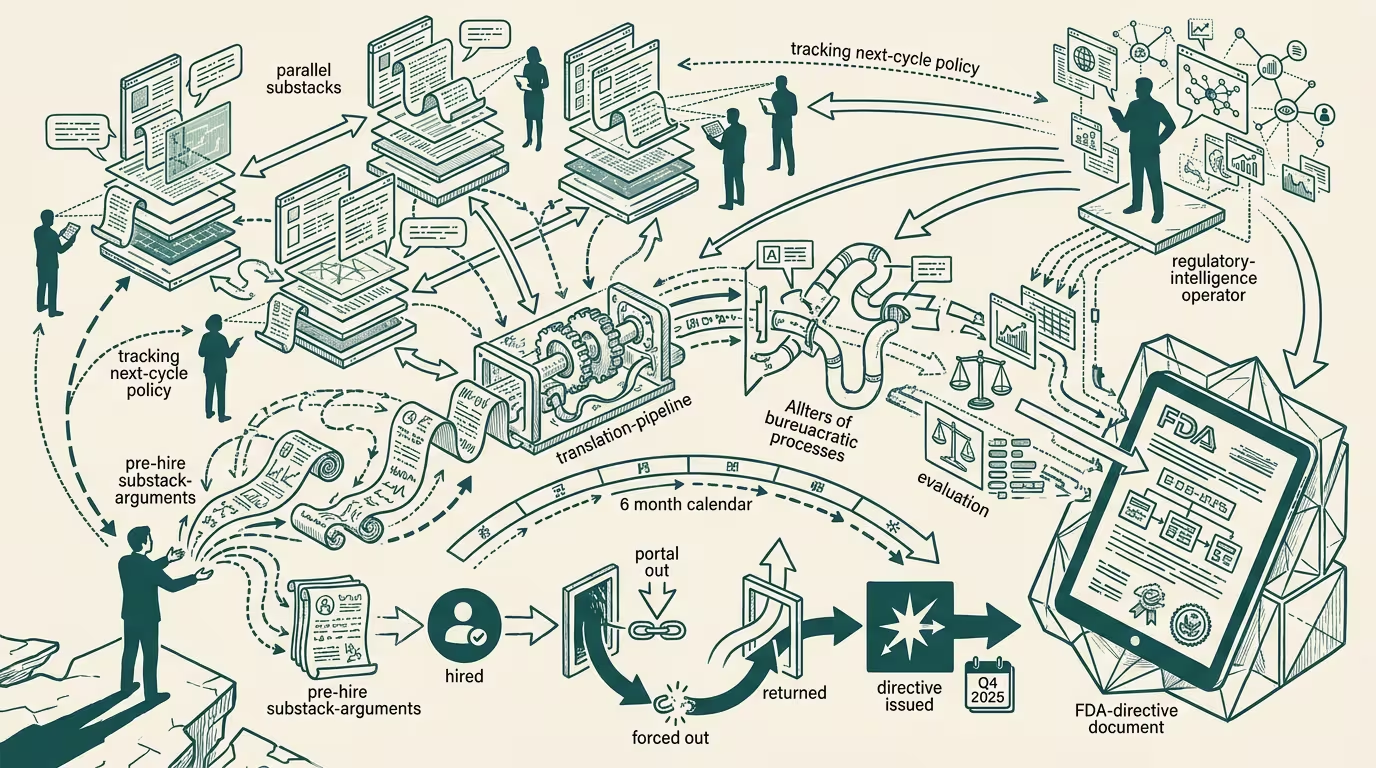
Vinay Prasad — academic oncologist, prolific Substack writer, frequent FDA critic — was hired into a senior FDA role in 2025. The hire was politically contested. He was briefly forced out, returned to the role within weeks, and by late 2025 had issued a three-page directive that translated his pre-hire Substack arguments on accelerated-approval pathways and surrogate-endpoint methodology into formal FDA policy guidance.
The trade press read it as a personnel story. The durable read is structurally sharper.
_The personnel-as-policy mechanism that drove healthcare regulatory shifts in 2024-2025 made the substack literally the policy._ Operators who weren't reading Prasad's substack pre-hire were reading the policy six months late.
Walk the personnel-policy translation cycle. Pre-hire, Prasad's substack carried a specific set of regulatory-policy arguments — skepticism of accelerated-approval pathways for oncology drugs, methodological critique of surrogate-endpoint usage, calls for stricter clinical-benefit-confirmation requirements. The arguments were operationally controversial in pharma-class circles and operationally reasoned in academic-class circles. By Q4 2025 the substack arguments were the formal FDA-directive language. The translation cycle was approximately six months from hire to formal policy.
Three things follow from that:
- _Personnel-as-policy is durable across the 2024-2026 healthcare regulatory environment._ Prasad is one example. The broader pattern includes other personnel hires whose pre-existing positions translated to formal policy after agency confirmation. The mechanism is operationally important because it gives operators a leading indicator — the personnel hire reads the policy direction with a 3-9 month lag depending on the agency's procedural cycle. Operators tracking healthcare regulatory shifts in 2024-2026 should be tracking personnel announcements at the same fidelity they track formal-policy releases. - _Substack-as-policy-document recurs beyond Prasad._ Several other healthcare-policy operators wrote substacks pre-hire that became operationally-relevant policy positions post-hire. The mechanism is not uniquely Prasad's. The broader phenomenon is that long-form-essay platforms became the policy-class workshop where the next-cycle policy positions were developed and tested before formal agency adoption. Operators with regulatory-class exposure should be reading the substacks of the personnel-class candidates who are likely to be hired into agency positions, because those substacks are the leading indicators for the formal-policy cycle. - _The adaptation is to read the substack ecosystem as policy-development infrastructure._ Pre-2024, operators tracked healthcare regulatory shifts through agency-press-release cycles, formal-rulemaking-comment cycles, and the trade-press coverage of those cycles. Post-2024, the move is to add substack-tracking to the regulatory-intelligence stack. The substack ecosystem is, in operating practice, where the policy-development happens before the formal-cycle absorbs it. Operators who don't track the ecosystem are operating with a 3-6 month information lag. Operators who track it operate with the same lead time as the personnel-policy translation cycle.
The thing that crosses pillars is that the personnel-as-policy mechanism, with substack-as-the-development-infrastructure, recurs across regulated categories beyond healthcare. Finance-policy: SEC and CFPB hires whose pre-existing positions translate to formal policy. Tech-policy: FTC and FCC hires whose pre-hire commentary becomes formal-policy direction. Energy-policy: EPA hires whose pre-hire writing becomes regulatory direction. Each category has its own substack ecosystem and its own personnel-policy translation cycle. The operator-class adaptation is the same — read the substack ecosystem as policy-development infrastructure.
Prasad's hire-and-directive arc is, on the available 2025 evidence, one of the cleanest examples of personnel-as-policy with substack-as-the-development-infrastructure. The mechanism is operationally durable. The adaptation is to add substack-tracking to the regulatory-intelligence stack. By 2027 the formal-cycle's lag behind the substack-cycle will be a standard regulatory-intelligence consideration. In 2026 it is operator-tier advantage for operators implementing the tracking now.
The FDA hired the substacker. The substack is now policy. Operators reading the substack pre-hire are operating-coherent. Operators reading the formal policy six months later are operating with the lag. The substack ecosystem has become, in operating terms, the policy-development infrastructure for the regulated-categories that operate against personnel-driven regulatory shifts. That includes healthcare. It increasingly includes the others.
—TJ