The Fed's 50bp cut changed the cost of capital for AI infrastructure. Here is what that means for your build-vs-buy math.
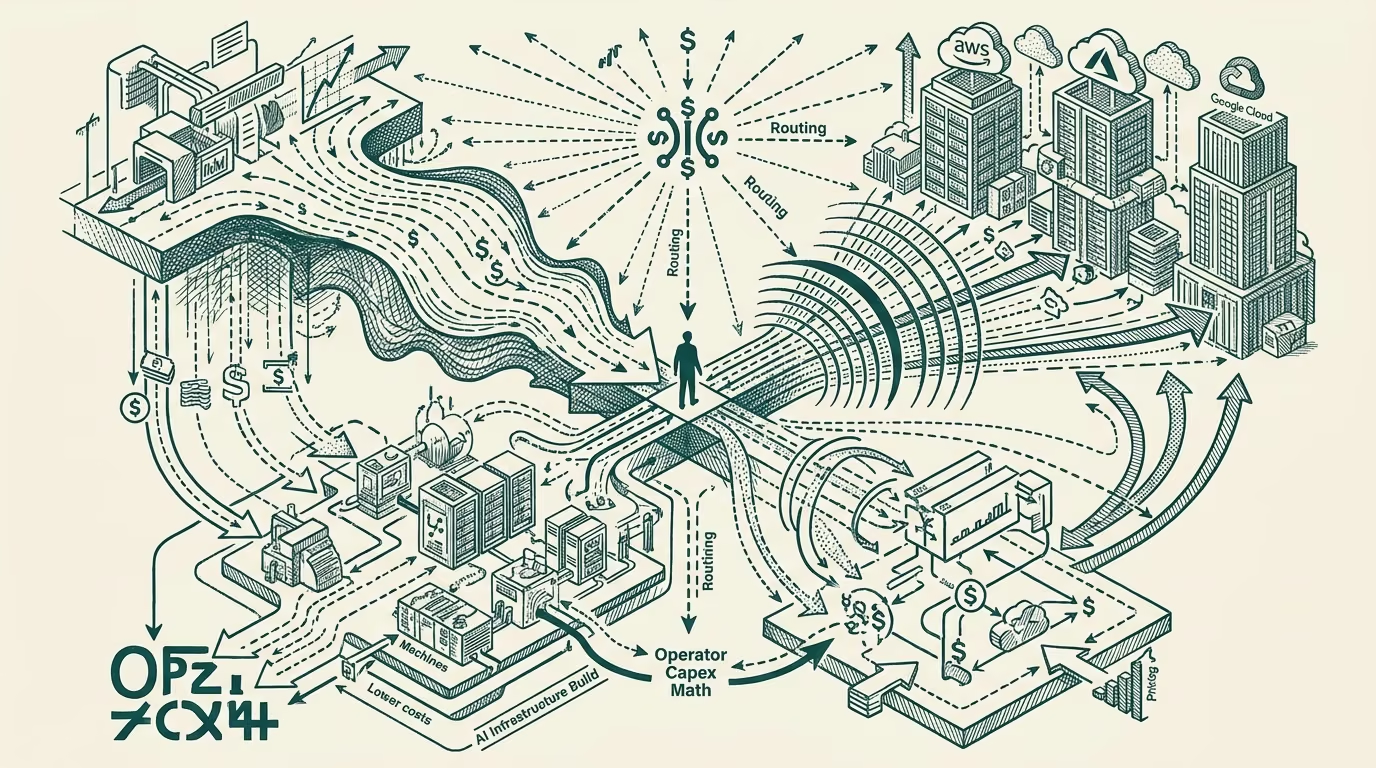
The Federal Reserve's 50 basis-point rate cut on September 18, 2024 was the first cut in four years and signaled the start of an easing cycle that has continued through 2024-2025. For the AI infrastructure category, the cut changed the cost-of-capital arithmetic in ways that the operator-class running build-versus-buy decisions should attend to carefully. The implications are two-sided.
The first effect is cheaper financing for AI infrastructure build-out. Operators considering owned-infrastructure deployments (on-premises GPU clusters, dedicated cloud-region commitments, specialty-hardware procurement) face improved cost-of-capital math. Multi-year capex commitments become more economically viable when the financing cost compresses, which lowers the bar for the build-tier decision relative to the rent-tier (cloud-API) alternative.
The second effect is signal-class. The Fed's easing cycle is the same signal the hyperscaler tier (AWS, Microsoft Azure, Google Cloud, plus the specialty AI-infrastructure providers like CoreWeave) reads to expand their own capacity-and-pricing posture. Cheaper capital for the hyperscalers translates into more aggressive capex deployment, which translates into pricing pressure on the rent-tier offerings the build-versus-buy decision evaluates against. The buy-tier becomes more competitive at the same time the build-tier's economics improve.
The two effects pull in opposite directions, with the net implication varying by operator scale and use case.
For operators at substantial scale (hundreds of millions in annual AI compute spend, multi-year deployment commitments, predictable workload profiles), the build-tier becomes more attractive because the cost-of-capital improvement compounds against the operator's substantial capex base. The hyperscaler-side pricing pressure helps but does not fully offset the build-tier's improving economics.
For operators at smaller scale (tens of millions or below, variable workload profiles, less predictable deployment commitments), the buy-tier remains the correct decision. The cost-of-capital improvement does not compound enough at the smaller scale to overcome the operational complexity of owned-infrastructure deployment, while the hyperscaler-side pricing improvement directly benefits the buy-tier.
For operators in the middle range, the math is genuinely close. The decision depends on workload predictability, the operator's capacity for infrastructure operational work, the strategic value of capacity-and-control beyond the pure cost arithmetic, and the cycle of model-and-hardware refresh the operator's deployment requires.
The Fed's easing cycle is likely to continue through 2025 absent unexpected inflation reacceleration. Operators running build-versus-buy decisions should expect the underlying cost-of-capital trajectory to continue favoring both sides of the decision in the dynamics described above. The durable read is to evaluate the specific deployment against the specific scale-and-workload profile rather than against a general framing.
For investors evaluating AI infrastructure investments, the read suggests that the hyperscaler-tier and the specialty-AI-infrastructure-tier are both positioned to expand through the easing cycle, with the operator-side allocation between build-and-buy varying by the scale-and-workload distribution of the customer base.
The Fed's 50bp cut was the visible signal of the easing cycle. The cycle changed the build-versus-buy arithmetic for AI infrastructure. The math runs in both directions. The operator-class running the decision should attend to the specific scale-and-workload profile rather than to the macro-class framing alone. The next 24-36 months will continue to test the build-versus-buy decision at progressively-larger scales, with the operators who run the math carefully producing better deployment-and-cost outcomes.
—TJ