Founder Mode is a permission slip. Manager Mode is a default.
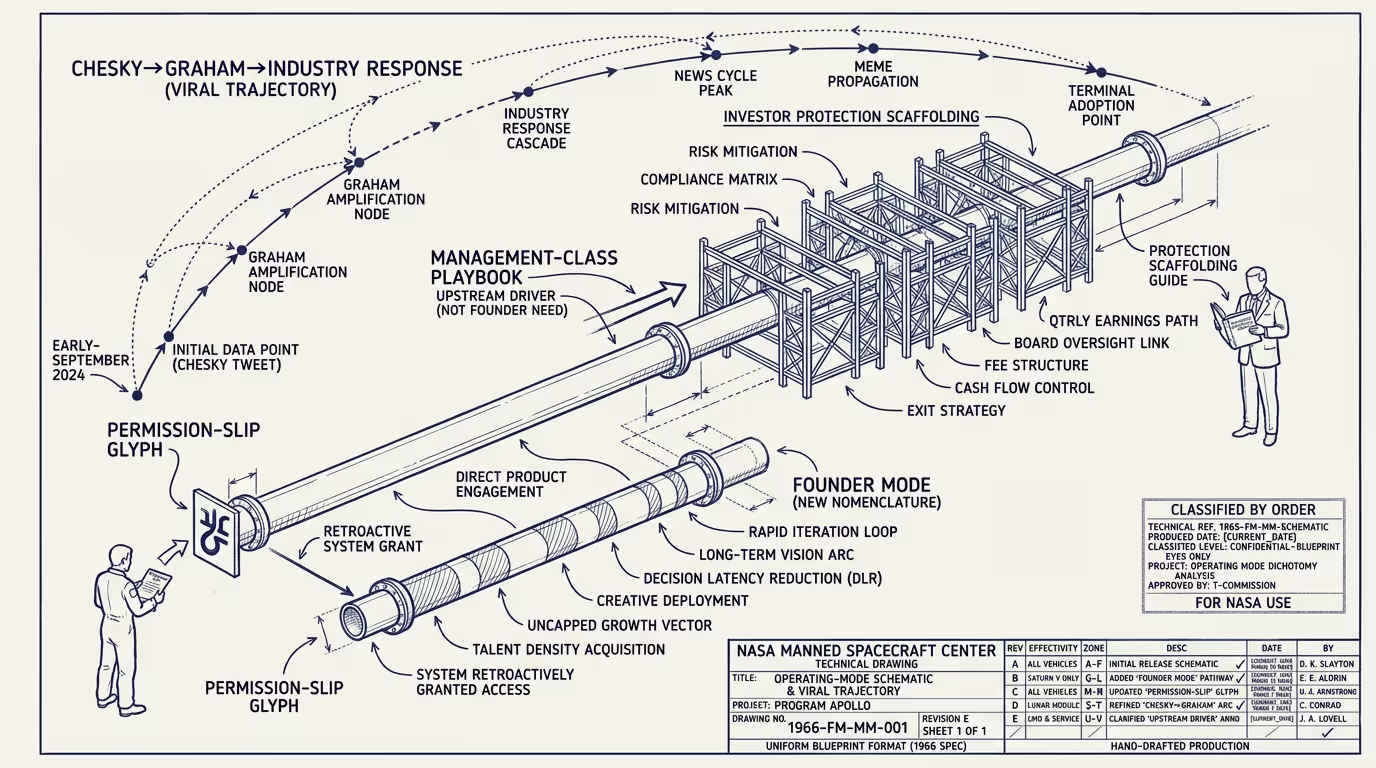
Paul Graham published "Founder Mode" on September 1, 2024, and the essay went viral within hours. The argument was that founders running their companies have been told for forty years to "hire good people and give them room," that this advice is calibrated to a professional-management class that is upstream of founder operating need, and that the founders who broke their companies trying to follow it (or, in Brian Chesky's case, almost broke their companies trying to follow it before they pulled out) had the experience that the advice was structurally wrong for them. Graham named the alternative "Founder Mode," sketched what it looks like, and admitted that nobody yet had a clean operational definition of it.
The viral arc is the interesting part.
Within a week the term was a meme. Within two weeks every operator-Twitter take on the topic had been written. Within a month Chesky himself was publicly distancing from the framing, telling Skift "I never called it Founder Mode," and pushing back against the micromanagement reading the term had taken on. By Q4 2024 the term had been absorbed into the standard operator vocabulary, simultaneously valorized and parodied, and the original Graham essay was, of course, already overshadowed by the discourse it had triggered.
The argument that holds the essay makes, beneath the meme, is the load-bearing one. The argument is that the management-class playbook of "hire good people and delegate" was developed in a different operating environment than the one founders typically run in. It was developed in mature companies where the institutional knowledge is distributed, where the strategic question has been settled and the tactical question is the live one, where the cost of a wrong delegation is contained by institutional process. None of those conditions hold in the company a founder is actually running, especially in years three to seven when the company is growing faster than its institutional process can absorb. The advice was not wrong. It was calibrated for a different context.
Founder Mode is, in this reading, not a personality trait. It is a permission slip. Specifically, the permission to do the things the management-class playbook tells the founder not to do: skip levels, run the customer-service inbox personally on bad weeks, sit in on the engineering review one floor below the layer where the engineering-VP is supposed to handle it, hire and fire on instinct rather than process, override the strategic plan when the data does not match it. None of those moves are sustainable as a permanent operating mode. All of them are necessary, intermittently, in the company a founder is actually running.
The reason the term went viral is that every serial founder reading the essay recognized the operating mode the essay was naming. The reason Chesky distanced from it is that the term got attached to the bad version of the operating mode, the version where the founder is genuinely just a micromanager who has not learned to delegate. Both are true. The term is doing work in the operator vocabulary; the term has also been hijacked by founders who use it as a permission slip for behavior the term was not endorsing. The viral arc is, of course, the cost of having a term at all.
What the essay tells operators choosing between operating modes is structurally important.
The default the operator class has been running on for forty years is Manager Mode. Manager Mode is what business school teaches, what HR processes are built around, what the management-consulting class structures their advice in. It is a defensible default because the alternative was, until Graham named it, undefined. The defensibility came from the absence of a competing frame, not from the operating evidence.
Founder Mode now exists as a competing frame. It does not work for everybody. It does not work in every operating context. It works in the specific context of a founder running a company that is growing faster than its institutional process, in a category that is structurally evolving, with a strategic frame that needs founder ownership rather than committee process. The frame is operationally narrow. Within that frame it is materially better than the manager-mode default.
The harder lesson is that most founders, most of the time, should be running some hybrid. The hybrid is hard because the hybrid does not have a name. The advice industry monetizes named frames; "run a thoughtful hybrid that adjusts to the moment" is not a marketable advice product. So the founder gets sold either Manager Mode (by the consulting and HR class) or Founder Mode (by the operator-Twitter class), and the right answer is roughly fifty-fifty most of the time.
thing that crosses pillars: the same advice-industry pattern that produced the manager-vs-founder-mode framing produces every other adjacent operating-frame debate. Move-fast-and-break-things vs measure-twice-cut-once. Strong-leader vs distributed-decision-making. Top-down vs bottom-up. In every case the advice industry sells a frame, the founder runs a hybrid, and the founder who admits to running a hybrid is the founder making the right call. Operators who pick a frame and defend it tend to be operators who have not yet been in the operating context where the other frame would have served them better.
The read that survives on Founder Mode three months after the essay landed is that Graham named a real operating mode, the meme outran the argument, Chesky was right to distance from the bad version of the term, and the term itself is now part of the operator vocabulary in a way that will outlast the discourse arc that produced it. That is, of course, what happens when an essay names something the operator class has been quietly recognizing for years. The naming is the contribution. The viral arc is the noise around the contribution.
The part that holds is to use Founder Mode as a permission slip when the operating context calls for it, and to run the manager-mode default when the operating context calls for that. The hybrid is the right answer most of the time. The advice-industry framing pretending you have to pick is, of course, the framing the operator should be the most skeptical of.
—TJ