I Have Always Been Here
A late new year's note about finally writing this stuff down.
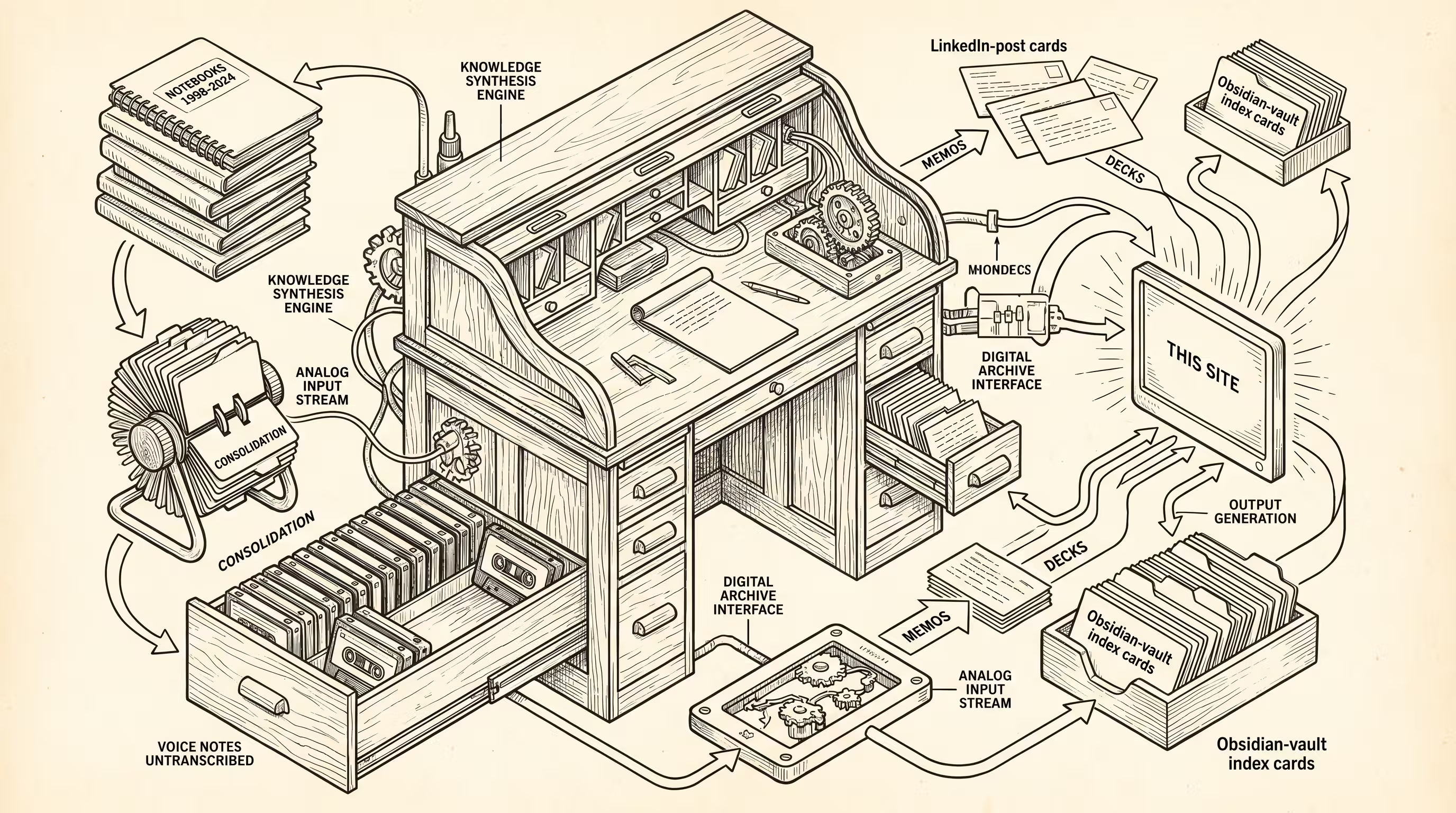
New year's resolutions are usually a way of writing down something you already suspect about yourself. This is mine, a week late, which feels correct.
The resolution is to finally journal properly, and to build a place where that journaling actually lives. For two decades, my thinking has been scattered across LinkedIn posts, private Obsidian vaults, half-finished Google Docs, voice notes I never transcribed, and roughly a hundred conversations where I said something I should have written down instead. Oh, and endless decks, memos to employees, town hall speeches. Pages of notes in cryptic shorthand across hundreds of notebooks. Some of it was sharp. Most of it was good enough to argue with. Almost none of it was in one place.
So: this site. A home for the thinking, going forward, and a slow consolidation of what's already been said.
I want to be clear about what this is and isn't, because it matters to me and probably to anyone who bothers to read carefully.
It is not a claim that everything here was written in real time. A lot of these pieces are drafts I've been carrying around for years, polished into something shareable. Some are new framings of old ideas. A few are reactions to things happening this week. The dates on individual posts are when they land here, not when the thinking started. If you want the real chronology, it's in my head, in my notes, and in one very specific document from 2007 that I'll get to in a minute. Either way, my life, my thinking, my writing all lean atemporal — I've learned to cope with it.
It is a genuine attempt to do the work of consolidation. Which means the ecosystem will look a little uneven at first. Not every piece will be the best version of its argument on day one. Some will get revised, a few more than once, and those revisions will be legible (dates, editor's notes, the usual). The point is not to launch a polished magazine. The point is to stop losing the thinking. (For me, this is the narrative side of an ever-evolving PKM.)
A note on drafting, since the question is fair and rising in 2024: I use LLMs the way I use spell-check and a good editor. They don't have opinions I didn't already have; they help me say what I meant to say faster. Where that's relevant I'll say so. Where it's obvious I won't belabor it. Every argument here is mine, and I'll defend every one of them on the merits.
The thesis
Here's the part that turns this from a blog manifesto into something closer to a confession.
In September 2007, I finished an MA thesis called Neo-nomads: Between 'Anyware' and 'Anyplace'. It was about mobility, work, and the people who were starting to treat geography as an optional parameter. It had two coined terms doing most of the load-bearing work. Anyplace described physical mobility: the cross-border, cross-jurisdictional churn of people whose work no longer sat in one country. Anyware was the virtual half: a continuum of tools, systems, and, specifically, non-human agents that would eventually make location into a preference rather than a constraint.
The thesis made three claims that I want to revisit here, because I've been quietly watching them for seventeen years and I think it's time to say what I saw.
The first claim was about AI. Not "AI" in the handwave-y futurist sense, but a concrete bet with a time window: that viable, non-hobby AI was twenty to twenty-five years out. I put the activation window at roughly 2027 to 2032, and I named non-human agents as civilization-scale actors — not tools, not products, but participants. In 2007 that read as a slightly weird graduate flourish. In 2024 it reads as a calendar entry.
The second claim was about discoverability. The thesis framed SEO as the practice of outsmarting predictive algorithms, which, at the time, meant Google's early PageRank-era scoring. Fine. What's interesting is the framing: not "ranking," not "search optimization," but a legible, almost adversarial relationship between an author and a predictive machine. A decade before the citation wars LLMs are kicking off right now, the thesis was treating the machine as a reader with taste. I think that's still the right frame, and I think the set of people who've been operating from it for two decades is small.
The third claim was buried in the Suggestions for further research section, which is where academics park the ideas they can't get to. Mine was cross-jurisdictional health and insurance friction: the practical, un-sexy, very real mess that sits at the seam between people who move and systems that don't. I spent the better part of the next decade building inside that exact gap. That wasn't a pivot. It was the footnote collecting on me.
I've posted the thesis on its own page with a summary, the key predictions, and a PDF. The short version: it's a 2007 document written by a much younger person, and I stand by its bets.
For the record, and because I enjoy this kind of corroboration, Michel Bauwens at the P2P Foundation picked the work up in July 2007, quoting a line I still like: "more and more tools exist to make working 'anywhere/anyware' plausible." It was also cited briefly on nettime.org the same month. Small corner of the internet, but a timestamped one, which is the part I care about.
Why now
Because the activation window opened.
In 2007, "2027 to 2032" was a twenty-year bet. In 2024, it's a runway. Agentic AI is here in a form the thesis described almost uncomfortably well: non-human actors making decisions inside human systems, at scale, with consequences we're going to spend a decade sorting through. Every conversation I'm in, with operators, investors, clinicians, travel executives, has some version of the same question underneath it: what do we do now that the machine is a participant?
I'd like to answer that question in public, across three territories I've been working inside the whole time:
- AI as the dominant frame, because it now shapes the other two and because I've been an operator inside applied AI since before it was a category worth putting on a business card.
- Travel, in what I'll call lament mode: an industry I helped scale globally and am now watching bleed out, with specific opinions about which intermediaries survive and which do not.
- Healthcare, post-exit, from having run Canada's largest healthcare marketplace through the exact cross-jurisdictional gap the 2007 footnote pointed at.
These aren't three adjacent interests. They're the three territories that thesis mapped, translated into a seventeen-year career, and now meeting at a point where the machine can finally do the things the 2007 version of me said it would.
The three-pillar structure you'll see here is not new positioning. It is a seventeen-year continuity finally made legible.
Ground rules
A few things I want on the record, so I don't have to repeat them:
I will make specific, time-bounded, falsifiable predictions. Some will be right. When they're wrong, there will be a was wrong about X but right about Y post, dated and linkable, because that's the only honest way to keep doing this.
I will cite myself when I've earned it, because the point of doing all this in the open is that the receipts exist. I'll be unapologetic about it.
I will name names when the argument requires it, and I'll keep personal attacks off the board. The distinction matters to me.
I will not pretend this site sprang up in a vacuum. It is a consolidation of a body of work that has been accumulating since roughly the year I defended that thesis, and bubbling up since childhood (thanks to Lem and Asimov, among others). If that makes the archive look a little strange in its first few months, fair.
That's the framing. I will not write another meta post like this. From here, the work does the talking.
I am a person who has been betting on the same few ideas since long before they were obvious, watching them inevitably show up on schedule, and I have waited long enough to start writing about them like I meant it.
—TJ