Itinerary rebooking is the right shape of agentic travel. Expedia finally agrees in its 10-K.
The 2024 trade-press coverage of agentic AI in travel ran heavily on the consumer-facing trip-planning use case. The chat agent that takes a free-text trip request and produces a complete itinerary. The recommendation engine that surfaces trip ideas. The conversational booking agent that handles the entire trip-planning conversation. These use cases captured the press attention and the venture-class funding, and as discussed elsewhere they have shipped at uneven quality with substantial gaps between the demo capability and the production reliability.
The agentic-travel use case that has been shipping cleanly through 2024-2025 is itinerary rebooking after disruption. The operator-class working in airlines, OTAs, and corporate travel management has been deploying rebooking-class agentic features and producing measurable operational results. Expedia's 10-K disclosure language through 2024-2025 has begun acknowledging the rebooking use case as the structural place where the agentic-AI investment is producing returns, which is the visible signal that the operator-tier read has finally shown up in the public reporting.
This piece walks why rebooking is the right shape, why the other agentic-travel use cases are not, three categories of vendor that have been shipping rebooking well, and what the durable read on the agentic-travel category should be.
Why rebooking is the right shape
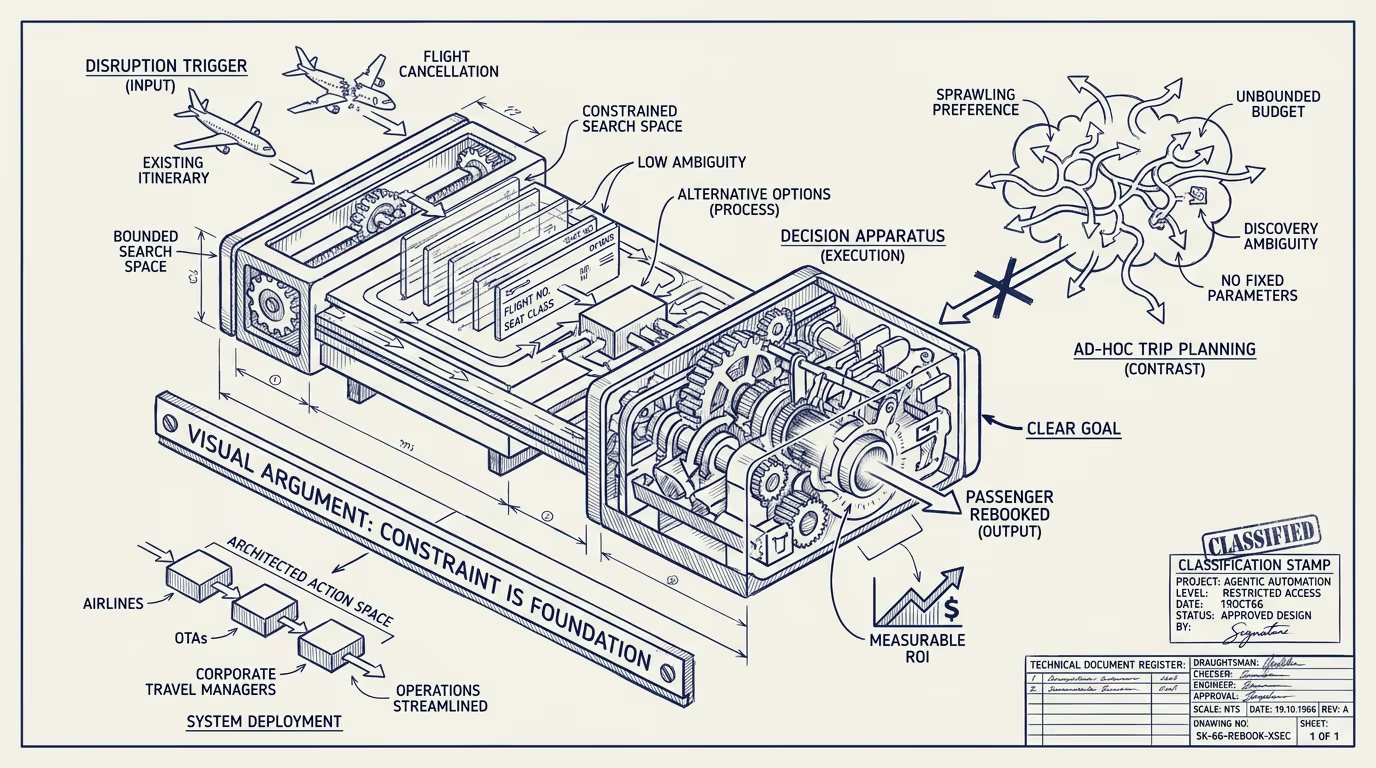
The agentic-AI shape works best on problems with four properties. The goal is clear and measurable. The constraints are explicit and bounded. The ambiguity in the user's intent is low. And the outcome can be evaluated automatically without requiring complex human judgment.
Itinerary rebooking after disruption hits all four properties cleanly. The goal is clear: the user's original itinerary has been disrupted (cancelled flight, missed connection, weather event, schedule change), and the user needs a replacement itinerary that gets them from where they are to where they are going within their existing constraints. The constraints are explicit: the user has a known destination, a known time window, an existing fare class and ticket structure, sometimes specific routing preferences, and the supply graph (the carrier's available rebooking inventory plus interline-and-cross-carrier options) is well-defined. The ambiguity in user intent is low: the user wants to be rebooked on something that works. The outcome is measurable: the rebooking either gets the user to their destination acceptably or it does not, and the user evaluates the result against a clear standard.
The four properties combine to produce a use case where the agentic system can reason against well-structured inputs, optimize against explicit objectives, generate solutions against bounded supply, and have its output evaluated cleanly. The shape of the problem matches the shape of what agentic AI does well in 2024-2025.
Why the other agentic-travel use cases are not the right shape
Compare the rebooking shape against the consumer-facing trip-planning shape. The goal is loose: the user wants a trip they will enjoy, with the definition of enjoyment varying widely across users and not being directly measurable. The constraints are mostly inferred rather than explicit: the user states some preferences, but the system has to fill in many constraints (budget tolerance, willingness to substitute, travel-style preferences, hotel-quality threshold) from incomplete information. The ambiguity in user intent is substantial: a user asking for "a trip to Italy in July" has dozens of underlying preferences the system has to guess. The outcome is hard to evaluate automatically: the trip-planning system's output has to be assessed against the user's eventual satisfaction, which is multi-factor and largely subjective.
The four properties run in the wrong direction for the trip-planning shape. The system is trying to do something with loose goals, inferred constraints, high ambiguity, and unmeasurable outcomes. The agentic-AI architecture struggles in this regime, and the production deployments of trip-planning systems have struggled accordingly.
The same analysis applies to most of the other agentic-travel use cases the trade press has been covering. Recommendation surfaces have moderate goal-clarity but substantial ambiguity. Conversational-booking flows have clear-ish goals but high ambiguity in the conversation-management. Multi-vendor coordination across airlines plus hotels plus activities has bounded constraints but high complexity in the cross-vendor reasoning. Each of these is structurally more difficult than rebooking, and the production reliability of the deployed versions reflects the structural difficulty.
Three categories of vendor shipping rebooking well
Three categories of vendor have been shipping rebooking-class agentic features at production reliability through 2024-2025.
The first category is the airline-direct mobile apps. Major U.S. carriers (Delta, United, American) have shipped agentic-rebooking features inside their own mobile apps, where the agent has access to the carrier's full operational data (the user's PNR, the operational status of the original flight, the carrier's rebooking inventory, the partner-airline connections via the carrier's interline agreements) and operates within the carrier's contract structure with the user. The rebooking agent in the carrier app is structurally the most reliable version because the data and the constraints are tightest.
The second category is the TMC-and-corporate-travel platforms. Navan (formerly TripActions), American Express Global Business Travel, and SAP Concur have shipped rebooking automation in their corporate-travel platforms, where the agent has access to the corporate traveler's profile, the company's travel policy, the corporate negotiated rates, and the broader supply graph through the GDS-and-NDC channels. The corporate-rebooking version is structurally close to the airline-direct version in reliability because the corporate-policy constraints add useful structure to the optimization problem.
The third category is the OTA platforms. Expedia and Booking have shipped rebooking-class features inside their consumer-facing apps, where the agent has access to the OTA's booking record, the major airlines' rebooking inventory through the GDS channels, and the alternative-routing options across the airlines. The OTA-rebooking version is structurally a step behind the airline-direct version because the OTA does not have the full operational visibility the carrier does, but it is shipping at workable reliability for the use cases that map cleanly onto the OTA-side data.
The three categories are running roughly the same shape of agentic-rebooking deployment, with the data-and-supply availability being the variable that determines the per-vendor reliability. The durable read is that the rebooking shape is the rebooking shape, and the vendors with the better supply data ship the better product.
What the Expedia 10-K language reveals
Expedia's 10-K disclosures through 2024-2025 have shifted to acknowledge that the company's agentic-AI investment has been concentrating on the rebooking-and-disruption-management use case rather than the consumer-facing trip-planning use case the company's earlier launch communications highlighted. The shift is not dramatic in the disclosure language; it is consistent across the reporting cycles in a way that signals the operational read has been confirmed. The company's deployment data through the 2024-2025 cycle has demonstrated that the rebooking use case produces the operational ROI that justifies the engineering investment, and the trip-planning use case produces less.
The 10-K language is the public version of the read the operator-tier working inside Expedia and the other major OTAs has been having internally. The trade press has been writing about the consumer-facing trip-planning launches as if those were the company's strategic bets. The 10-K language is signaling that the strategic bets are elsewhere, in the rebooking-and-disruption category, where the operational ROI is real and the engineering investment compounds.
What the operator class should take from this
For founders building agentic-travel products in 2025-2026, the operator read is to build for the rebooking shape and adjacent use cases (interline-and-cross-carrier coordination, accommodations rebooking when a hotel cancels, ground-transportation rebooking when a connecting flight is missed, group-travel coordination after weather events, the broader disruption-management category) rather than the trip-planning consumer-facing category that has dominated the press coverage.
The rebooking-shape category has a buyer who pays. The OTA, the airline, and the TMC are all willing to pay for products that improve their disruption-management metrics, because the cost of unmanaged disruption (customer-service queue depth, compensation costs, reputational damage, retention impact) is well-understood and large. The trip-planning-shape category has a buyer who is harder to monetize, because the consumer-facing flows have the consumer-acquisition-cost problem and the OTA-take-rate compression discussed elsewhere.
For investors evaluating the agentic-travel category, the read suggests that the rebooking-and-disruption-management vendors are operating with better unit economics than the trip-planning vendors, and that pricing the two categories with the same multiple framework misses the structural difference in the agentic-fit between the two shapes.
For the trade press, the read suggests that the visible launch-and-demo cycle in the agentic-travel category has been concentrated on the wrong half of the use-case landscape, and the under-reported half is where the deployment volume and the dollar returns actually live.
The agentic-travel category will continue to ship trip-planning products and the trade press will continue to cover them. The operator-grade returns are concentrated on the rebooking-and-disruption-management half of the category, with three categories of vendor shipping cleanly and an Expedia 10-K disclosure now signaling that the read has filtered through to the public reporting. The right shape of agentic travel is the rebooking shape. The other shapes are mostly press-friendly demos. The operator building in this space should pick the right shape and build for it. The early movers who do are running ahead.
—TJ