The NDC migration is six years late and still wrong.
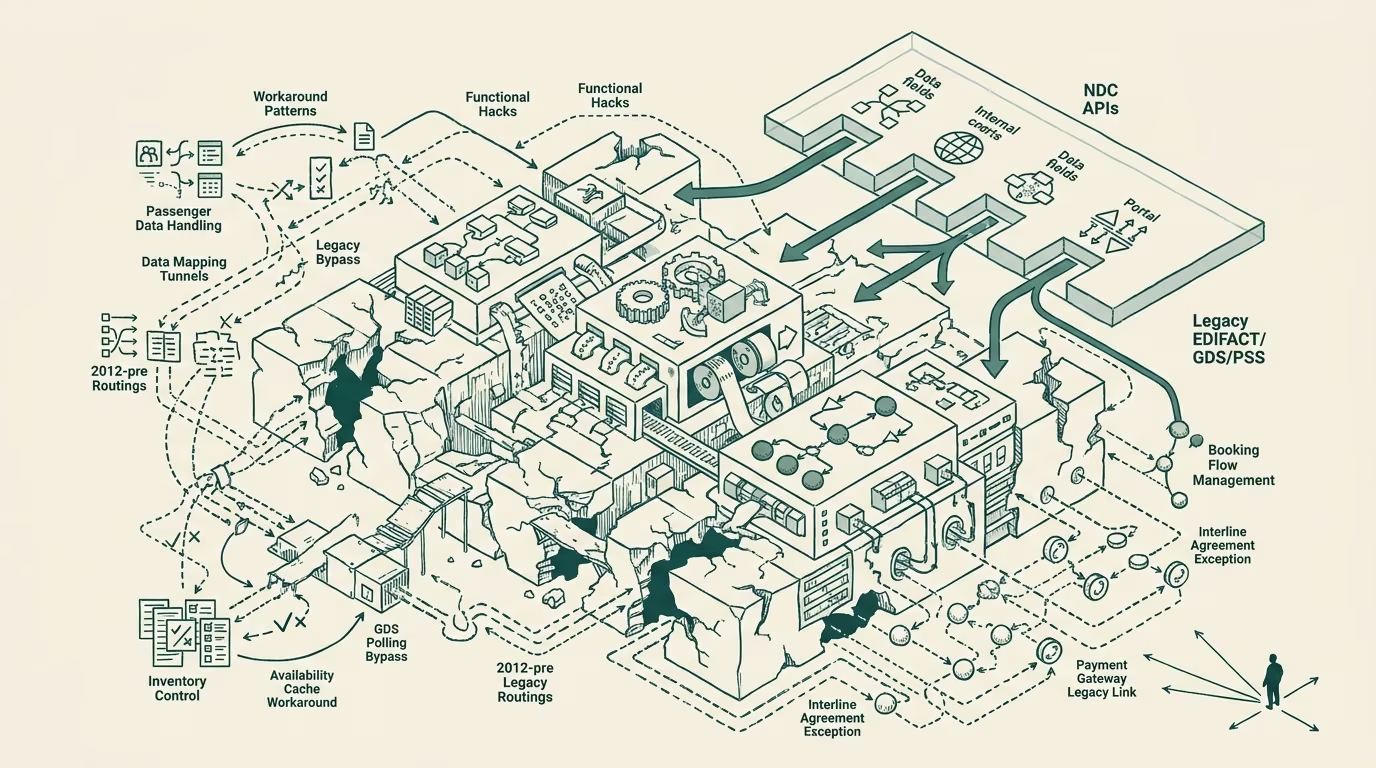
The IATA New Distribution Capability standard was first ratified in 2012, expected to be substantially deployed across the airline industry by 2018, and was supposed to retire the legacy distribution stack of EDIFACT messaging running through the global distribution systems. By 2024 the deployment has substantially shipped: the major airlines run NDC-compliant API surfaces, the major GDS providers (Sabre, Amadeus, Travelport) have NDC support in production, and the volume of bookings flowing through NDC channels has grown from negligible to meaningful across the largest carriers.
That is the promotional version of the story, which the trade press has run somewhere between accurately and over-charitably. The operator-class version is different. The NDC migration shipped the wire format, mostly. It did not ship the operating capability airline IT teams actually need, and the workarounds the IT teams continue to deploy in 2024 are the same workarounds the legacy stack required, with NDC sitting underneath them as a wire-format substitution rather than a capability upgrade. The migration is, in operator-grade terms, six years late and still wrong.
This essay walks the gap. The 2012 promise versus the 2024 reality. Three concrete workaround patterns that airline IT teams continue to ship despite NDC being in production. And what the structural lesson is for distribution-standard work that runs through industry-consortium processes.
What NDC promised in 2012, and what shipped by 2024
The 2012 promise, articulated in the IATA presentations and the early-stage trade-press coverage, was that NDC would replace the legacy EDIFACT distribution layer with a modern XML-and-JSON API surface that would enable rich-content distribution, dynamic pricing, ancillary-product bundling, personalization at the offer-and-order layer, and a unified order-management capability that would let airlines manage the full customer journey from offer through fulfillment in a single coherent system.
What shipped by 2024 is a wire-format upgrade with selected capability uplifts. The XML-and-JSON API surface exists. The rich-content distribution works for some categories of content (seat maps, fare-class descriptions, basic ancillary products). Dynamic pricing has shipped in pieces, with the major airlines running it for selected route-and-segment combinations and not running it for others. Ancillary-product bundling works at the simple level (seat plus baggage plus meal) and breaks down at the operationally interesting level (multi-leg trips with mixed-fare segments, codeshare itineraries with partner-airline ancillaries, loyalty-status-modified pricing across the bundle). Personalization at the offer-and-order layer is partially shipped, mostly in the major carriers' direct-channel experiences and not in the indirect-channel NDC distribution.
The unified order-management capability is the gap that the operator class talks about and the trade press generally does not. The 2012 NDC vision included a single order-management state that would supersede the legacy PNR-record-locator architecture. The 2024 reality is that most airlines run NDC orders alongside legacy PNRs, with synchronization layers between them that are themselves a meaningful share of the airline-IT operating cost. The single-source-of-truth promise of NDC order management has not been delivered. The airlines that committed hardest to it are operating dual systems with sync-layer overhead. The airlines that committed least to it are running NDC as a wire-format on top of substantially-unchanged legacy operating systems.
Workaround one: the order-state synchronization shim
The first workaround pattern is the order-state synchronization shim that almost every airline running NDC in production has shipped. The shim sits between the NDC order-management API and the legacy PNR-record-locator system, translating state transitions in either direction so that the airline's downstream systems (revenue accounting, operational systems for irregular operations, customer-service tooling, loyalty crediting, the carrier's mobile app and website) can continue to operate against the legacy data model while the NDC distribution layer operates against the modern one.
The shim is operationally expensive. It requires a meaningful staffing footprint to operate in production, with on-call rotation for the cases where the synchronization fails (which it does, regularly, in ways that cause customer-facing service problems). The shim is also architecturally a problem, because it ties the airline's ability to retire the legacy systems to the readiness of every downstream system to operate natively against NDC order state, which has been a multi-year project at most carriers and is not on track to complete in the near term.
The 2012 NDC vision did not include the synchronization shim. The shim was supposed to be unnecessary because the legacy systems were supposed to retire. The retirement did not happen on schedule, the shim shipped to fill the gap, and the shim is now a permanent fixture of airline-IT operating infrastructure rather than a transitional artifact.
Workaround two: the GDS-NDC bidirectional translation
The second workaround pattern is the bidirectional translation layer between the GDS systems and the NDC API surface. Travel agencies, corporate travel management companies, and online travel agencies continue to operate substantially against GDS interfaces, because the GDS interfaces have richer aggregation across multiple airlines and because retraining the agency-tier workforce on NDC-native interfaces is a multi-year capability investment that the agency-tier has been generally unwilling to undertake at scale.
The result is that bookings flowing through the agency-tier need to be translated from GDS interface conventions into NDC API calls, and back, with multiple round-trips through translation layers operated either by the GDS providers or by the airline-IT teams. The translation is lossy in practice. Ancillary products that the airline expects to be bookable through NDC do not always make it through the GDS-NDC translation layer; pricing flexibility that the airline wants to express through NDC dynamic pricing gets compressed into the GDS-conventional fare classes when it has to round-trip through GDS interfaces; loyalty-and-personalization signals that the airline can express in direct-channel NDC do not survive the agency-tier round-trip.
The trade press writes about NDC distribution-share growth as if the growth were the metric. The operator class watches the GDS-NDC translation losses as the metric, because the translation losses are where the customer-experience differentiation that NDC was supposed to enable is lost in transit between the airline and the agency-tier. The airlines that have prioritized direct-channel NDC have captured most of the NDC-distribution upside. The airlines that have continued to depend on the agency-tier for distribution have captured substantially less of it.
Workaround three: ancillary normalization across legacy and NDC
The third workaround pattern is ancillary-product normalization. Airlines have spent the better part of a decade building out ancillary-product catalogs (seat selection, baggage, meals, premium-seating upgrades, lounge access, priority-services, in-flight wifi, expedited-security memberships) that need to be representable consistently across both legacy and NDC distribution channels and across direct-and-indirect distribution.
The normalization layer is its own engineering effort. The NDC standard provides the data model for ancillary products, but the operational complexity of mapping every airline's actual ancillary catalog to the NDC data model, plus the legacy data model, plus the carrier-specific extensions each airline has built into both, plus the partner-airline ancillaries that need to be representable for codeshare itineraries, plus the loyalty-status-modified pricing for ancillaries: this is engineering work that did not exist in the 2012 NDC vision and that consumes a meaningful share of airline-IT engineering capacity in 2024.
The result is that ancillary-product distribution is partially-shipped on NDC and partially-shipped on legacy infrastructure, with the same product needing to be represented on both, and the airline needing to maintain a normalization layer that keeps the two in sync. The single-source-of-truth ancillary catalog that NDC was supposed to enable has not shipped. Most airlines run multiple sources of truth for ancillaries with sync infrastructure between them.
What this leaves the operator class with
The structural lesson for the operator class building airline-IT, distribution, or related travel-tech in 2024-2025 is that NDC is not the standard the 2012 vision described. It is a wire-format upgrade with partial capability uplift, sitting on top of a layer of workarounds that the operator class continues to ship, and the workarounds are not transitional. The workarounds are the steady-state architecture for the foreseeable future, because the underlying retirement-of-legacy-systems work that NDC was supposed to enable has not been delivered and is not going to be delivered on the original timeline.
For the founder building distribution-tech for the airline category, this means that the right product to build is one that operates inside the workaround architecture, not against the NDC vision. The airlines are not going to throw away the synchronization shims, the GDS-NDC translation layers, and the ancillary-normalization infrastructure. They are going to operate them for the next decade. Products that integrate cleanly into that operating architecture have a market. Products that pitch the airlines on the NDC-vision-future where the workarounds are gone are pitching against an architecture the airlines do not have and are not building toward.
The broader lesson is that distribution-standard work running through industry-consortium processes (which is most distribution-standard work, in most industries) tends to produce wire-format upgrades rather than operating-capability upgrades, because the consortium process can agree on the wire format more easily than it can agree on the operating-capability redesign. The airlines that committed to the operating-capability redesign got partial value out of NDC. The airlines that committed to the wire-format substitution got the wire-format substitution and a layer of workarounds. Both are operating in 2024 against the gap between what the standard promised and what shipped, and the gap is structurally where the operator work continues to live.
The NDC migration is six years late and still wrong. The trade press has been generally polite about that. The part that holds on it is closer to the title.
—TJ