Ontario's primary care shortage is not a supply problem. It is a routing problem TJ already solved once.
Ontario's February 2024 public-commentary cycle on the primary-care shortage ran heavily on supply-framings. The Ontario College of Family Physicians estimated approximately 2.3 million Ontarians without a family doctor, with the projected number rising past 3 million by 2026 if the trajectory continued. The provincial response, calibrated against the supply framing, included expanded medical-school seats, fast-tracked international-medical-graduate certification, financial incentives for primary-care practice, and various recruitment-and-retention programs. The investment scale was meaningful and the political-class commitment was visible.
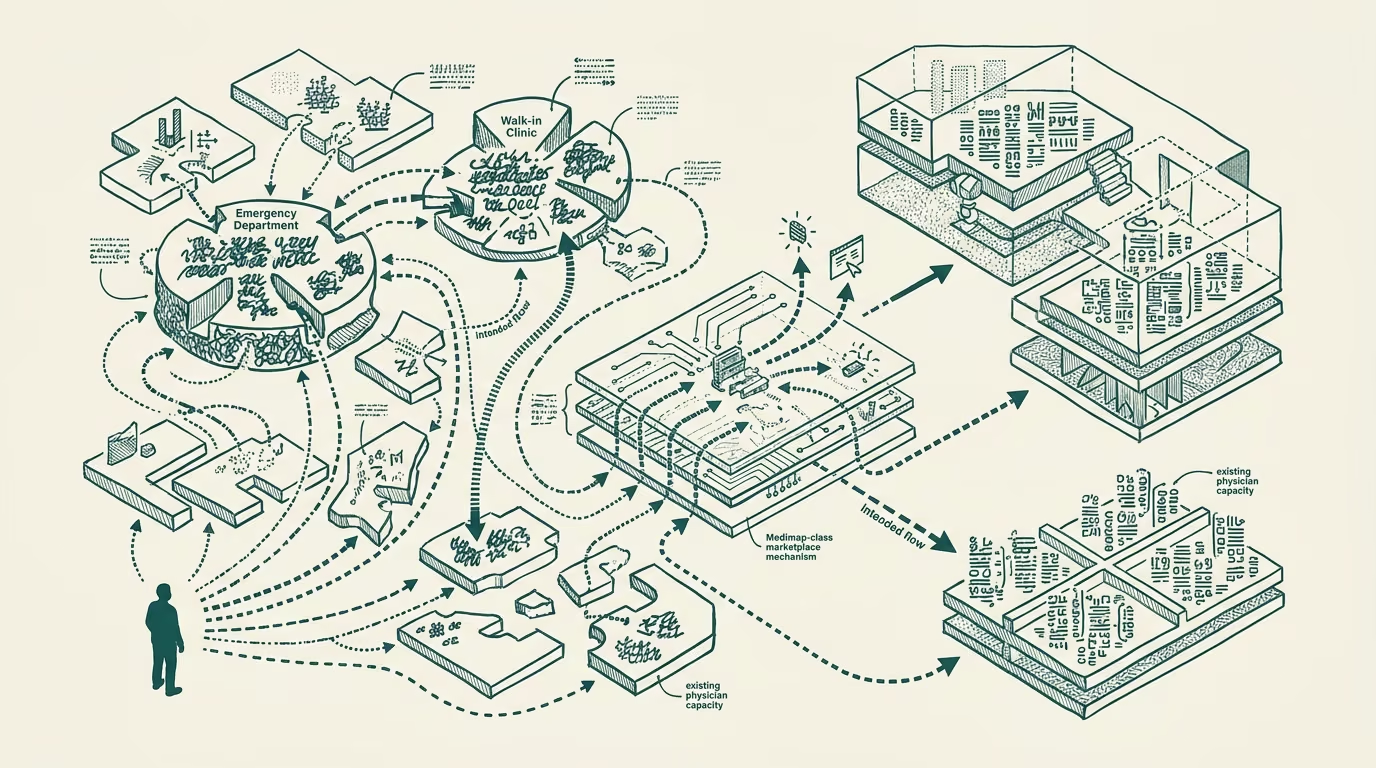
The structural read on the problem is different. Ontario does not, primarily, have a supply problem with primary-care physicians. Ontario has a routing problem with the demand for primary-care services, with the routing failure producing the unattached-patient population, the over-utilization of emergency departments and walk-in clinics for primary-care-class problems, and the under-utilization of substantial primary-care capacity that exists in the system but is not reaching the patients who need it.
This piece walks the supply-vs-routing distinction, the data that supports the routing framing, what the routing-layer fix actually looks like, and why the current public-investment trajectory is sized against the wrong problem.
The supply-vs-routing distinction
The supply framing of the primary-care shortage assumes that the number of primary-care physicians is the binding constraint. The framing implies that adding more physicians (through expanded training, IMG certification, retention programs) would close the gap by increasing the total primary-care capacity in the system.
The routing framing assumes that the number of primary-care physicians is roughly adequate (with substantial geographic-and-distribution variance) and that the binding constraint is the matching mechanism that connects patients with available primary-care capacity. The framing implies that improving the matching mechanism would close most of the gap without requiring substantial additional supply.
The two framings produce substantially different policy responses. The supply framing produces investment in training-and-recruitment infrastructure on a multi-year-to-decade timeline. The routing framing produces investment in matching-and-coordination infrastructure on a 12-36-month timeline.
The data that supports the routing framing
Several lines of data support the routing framing as more accurate than the supply framing.
The first line is the geographic-and-practice-distribution data. Ontario's primary-care physician supply is unevenly distributed across the province, with substantial concentration in the major urban centres and structural under-supply in the rural-and-northern regions. The unattached-patient population, however, is not concentrated in the under-supplied geographies; it is distributed across both well-supplied and under-supplied areas. The pattern is consistent with a routing failure rather than a supply failure: there are enough physicians in many regions, but the matching infrastructure does not connect the unattached patients to the available capacity.
The second line is the practice-capacity utilization data. Many primary-care practices in Ontario are not at maximum patient-roster capacity, with the variance being substantial across practices. Some practices are full or over-full; others have meaningful unused capacity. The variance is consistent with a routing failure: the unattached-patient population is not being matched to the practices with available capacity.
The third line is the walk-in-clinic and emergency-department utilization data. A substantial share of walk-in-clinic and ED visits in Ontario are for primary-care-class issues that would be more appropriately handled in a primary-care setting. The over-utilization of these channels is consistent with patients who are unattached and routing themselves to walk-in or ED in the absence of a primary-care relationship. The pattern is again consistent with routing failure rather than supply failure.
The fourth line is the international-comparison data. Other healthcare systems with similar physician-to-population ratios as Ontario produce substantially better attachment rates because their matching-and-coordination infrastructure is more developed. The comparison is consistent with the routing-layer being the variable that explains the variance in attachment rates across systems.
What the routing-layer fix looks like
The routing-layer fix that the data supports has several components.
The first component is patient-attachment infrastructure. Provincial systems that have invested in centralized or regionally-coordinated patient-attachment registries, with patient-side application infrastructure and provider-side capacity-tracking, produce substantially better attachment rates. The infrastructure does not create new physicians; it connects unattached patients to practices with available capacity.
The second component is care-team configuration. Primary-care practices that operate as multi-disciplinary teams (physicians, nurse practitioners, registered nurses, pharmacists, social workers, mental-health professionals) can serve substantially larger panels per physician than physician-only practices. The team-based configuration is a routing-layer fix because it routes appropriate clinical questions to the team-member best positioned to address them, rather than routing every clinical question through the physician.
The third component is digital-routing infrastructure. AI-augmented routing tools that match patients to appropriate clinical resources (a primary-care practice, a walk-in clinic, a virtual-care service, an after-hours support line) based on the urgency and type of their concern can substantially improve the matching efficiency in the system. The Medimap-class marketplace mechanism that addressed walk-in-clinic capacity demonstrated this pattern at the walk-in scale; the same mechanism extends to the broader primary-care attachment problem.
The combined effect of the three components is that the routing-layer fix can substantially improve attachment rates without requiring the supply expansion that the supply framing implies. The investment scale is meaningful but smaller than the multi-year supply-expansion investment, and the timeline is faster.
Why the current investment trajectory is sized against the wrong problem
Ontario's public investment in the primary-care shortage through 2024-2025 has been concentrated heavily on the supply-side framings: expanded medical-school seats, IMG certification programs, recruitment-and-retention financial incentives. The investment is not unhelpful, but it is sized against the supply-framing assumption that the binding constraint is the number of physicians.
If the binding constraint is actually the routing layer, the supply-side investment will produce slow and partial improvements (additional physicians help at the margin, but the routing failure persists), while the underlying problem continues to compound. Patients added to the system through supply-expansion continue to experience the routing failure, with the consequence that the attachment metrics improve more slowly than the supply-side investment alone would imply.
The corrective trajectory requires shifting some of the supply-side investment into routing-layer investment. The political-and-bureaucratic difficulty of the shift is real, because the supply-framing has stronger institutional advocates (the medical schools, the recruitment-and-retention bureaucracy, the various professional bodies) than the routing-framing does. The data, however, supports the shift, and the operator-class read on the problem suggests the shift would produce faster and larger improvements in the attachment-and-utilization metrics.
The Ontario primary-care shortage is not a supply problem in the central case. It is a routing problem with a supply-class secondary-component. The routing-layer investment is the lever that produces the largest improvement on the timeline that matters, and the public-investment trajectory should be revised accordingly. The data has been there since the 2010s; the framing-shift is the work that has not happened. Operators reading the data carefully should be advocating for the routing-framing in the public-policy discussion. The supply-framing will continue to produce its slow improvements; the routing-framing would produce the larger ones, on the faster timeline, if the policy class shifted toward it.
—TJ