OpenAI Operator is the demo of what every travel and healthcare booking flow needs in 18 months.
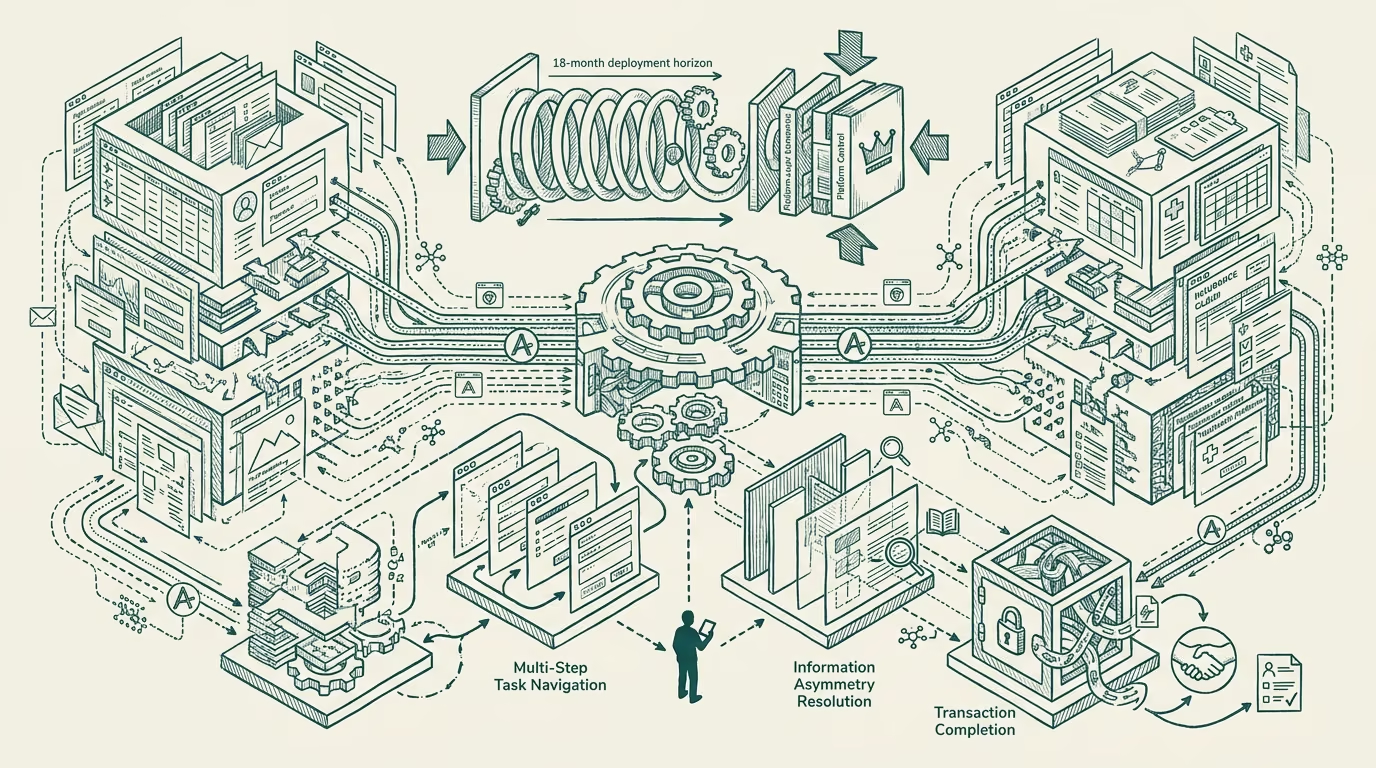
OpenAI released Operator in January 2025 as a browser-agent capability that handles multi-step tasks by reading and acting on web pages the way a human user would. The launch demonstrations included travel-booking workflows (researching options, comparing prices, completing reservations) and healthcare-logistics workflows (scheduling appointments, navigating patient-portal interactions, managing prescription-and-pharmacy interactions). The demonstration was operationally meaningful because it surfaced, in a single product release, the durable read that has been visible to the operator-class for some years: travel-booking and healthcare-navigation are substantially the same UX problem.
The 18-month horizon for category-class deployment of equivalent capability is short. By mid-2026 the major OTAs, the major payer-and-provider organizations, and the broader specialty-vendor population in both categories will have shipped Operator-class browser-agent capability. The launch demonstration is the visible signal of where the deployment trajectory is going. The operator-grade read is to attend to the platform-layer economics that will determine which entities capture the durable value-creation flowing through the deployment.
This essay walks the demonstration, the durable read on travel-and-healthcare convergence, and the platform-layer economics question that determines which entities benefit from the convergence.
What the demonstration showed
The Operator demonstration showed an AI agent operating a browser to complete multi-step tasks the way a human user would: reading the page, making decisions about what to click, filling forms, navigating across multi-page workflows, handling unexpected page-states (errors, captchas, multi-step confirmations). The capability is impressive on its own terms; the more interesting question is what the capability implies about category-class workflow design over the next 18-36 months.
The travel-booking workflow demonstration ran against publicly-available travel websites (OTAs, supplier-direct sites, the various intermediary tools the consumer would use). The healthcare-logistics demonstration ran against publicly-available patient-portal and pharmacy-website surfaces. Both demonstrations completed multi-step tasks that took human users substantial time and attention, with the agent producing comparable outcomes in compressed time.
The demonstration is not the product. The production deployment of equivalent capability requires the engineering-and-deployment work that the launch demonstration glossed over: error-recovery infrastructure, audit-and-trail mechanisms, the broader operational-quality posture that production deployment requires. The 18-month horizon reflects the time the major operators in each category need to ship the production-quality version of the demonstrated capability.
The structural read on convergence
The durable read that travel-booking and healthcare-navigation are the same UX problem has been visible to the operator for some years. Both categories share several structural features.
Both involve multi-step transactional workflows that the consumer cannot complete in a single interaction. Both involve substantial information-asymmetry between the consumer and the supply-side. Both involve regulatory-and-compliance constraints that shape what the consumer can do at each step. Both involve loyalty-and-account relationships with multiple supply-side entities (multiple airlines and hotels in travel; multiple providers, payers, pharmacies in healthcare). Both involve event-driven workflows where unexpected disruptions (delays, cancellations, denials, scheduling conflicts) require multi-step recovery.
The Operator-level capability demonstrates that a single AI agent can handle the multi-step workflow shape across both categories. The implication is that the platform-layer that captures the agent-mediated workflow value will, structurally, be the same platform across the two verticals. Whichever entity captures the durable platform-layer position in agent-mediated workflow management will hold a position that spans travel-class and healthcare-class booking-and-logistics work.
The platform-layer economics
The platform-layer economics question is which entity captures the durable value-creation flowing through the agent-mediated workflow.
Several candidates compete for the position. The foundation-model vendor that owns the underlying agentic capability has a position because the capability is what enables the workflow. The browser-and-OS-platform vendors (Google Chrome, Apple, Microsoft) have a position because the agent operates inside the browser-and-OS environment. The vertical-specialty vendors that have deep integration with the supply-side (the existing OTAs in travel, the existing patient-portal-and-pharmacy vendors in healthcare) have a position because the agent operates against their existing infrastructure. The aggregator-class vendors that route the agent's actions across multiple supply-side entities have a position because the routing-layer is where the cross-vendor coordination happens.
The historical pattern from prior platform-layer transitions (search, mobile, cloud) suggests that the platform-layer value tends to concentrate at one or two of the candidate positions, with the other positions being absorbed or marginalized. The specific position that captures the value depends on which candidate has the strongest combination of capability investment, distribution reach, and customer-relationship depth.
For the next 18-36 months, the position that captures the durable economics is, in my read, most likely the foundation-model vendor that owns the agentic capability plus the aggregator-class vendor that handles the cross-supply-side routing. The browser-and-OS-platform vendors have advantages but have been slower to ship the agentic capability at the production-quality level the deployment requires. The vertical-specialty vendors have advantages on the supply-side integration but face the structural problem that the agent-mediated workflow tends to commoditize the supply-side integration that was the specialty vendor's moat.
What this leaves the operator class with
For founders building products in either category in 2025-2026, the practical advice is to build for the agent-mediated workflow shape rather than the human-user-mediated workflow shape. The 18-month horizon means that products built against the human-user-mediated assumption will face structural displacement as the agent-mediated capability ships across the major operators.
For investors evaluating products in either category, the read is similar. The human-user-mediated workflow products are exposed to the agent-mediated transition; the agent-mediated workflow products are positioned for the trajectory.
For operators in the travel and healthcare categories specifically, the part that holds is that the convergence between the two categories at the agent-mediated layer is real and produces strategic implications that span the two verticals. Operators who treat the categories as structurally distinct miss the cross-vertical platform dynamics. Operators who treat them as structurally similar are better-positioned for the next 18-36 months.
OpenAI's Operator was the demo. The production deployment of equivalent capability is the trajectory. The platform-layer economics question is the central durable read. Build for the agent-mediated workflow; the human-user-mediated workflow is the legacy shape the next category-cycle will progressively retire.
—TJ