The OTA isn't a destination. It's a click-out tax.
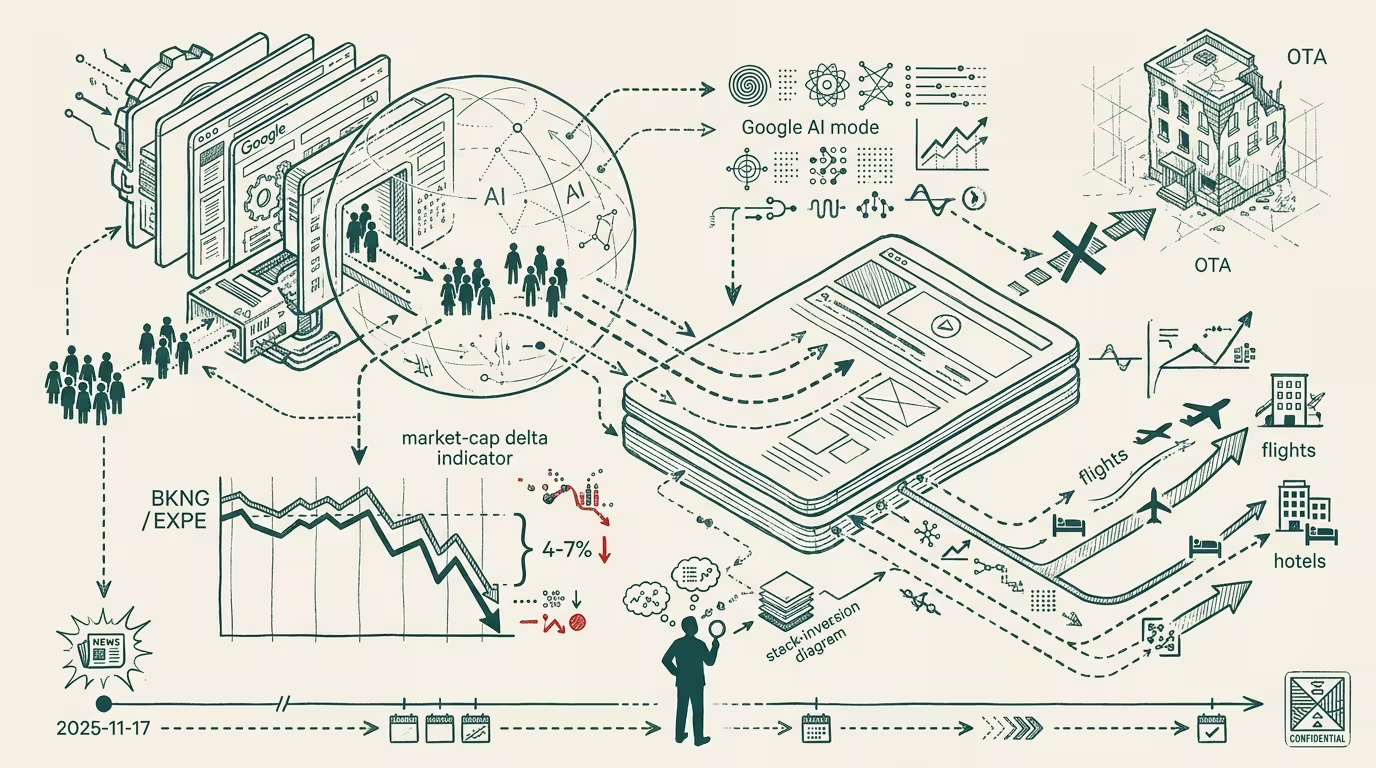
Google announced AI Mode agentic booking on November 17, 2025. The initial scope: restaurants. The roadmap explicitly named flights and hotels as next-quarter expansions. Within hours of the announcement, Booking Holdings and Expedia shares dropped 4-7% on regular trading volume. The drop wasn't speculative noise. It was a real-time investor-class pricing event on AI booking adoption rates.
This piece treats the announcement as a case study in distribution-stack inversion, then opens to the operator-class playbook for OTAs facing the inversion.
The case study: AI Mode mechanics + the click-out economics it disrupts
Google AI Mode agentic booking keeps the user inside Google's interface from search intent through transaction completion. Pre-AI-Mode, a user searching for "best Italian restaurant in Brooklyn" would receive search results, click through to OpenTable or Resy, complete the reservation on the third-party platform, and return to Google for the next query. That click-out was the revenue mechanism for the third-party platform — it captured the user's transaction intent and monetized through subscription fees, transaction fees, or partner commissions.
Post-AI-Mode, the user receives the agentic-booking interface directly inside Google, completes the reservation without leaving Google, and the click-out doesn't happen. OpenTable and Resy lose visibility into the user's intent and lose the transaction-completion event that supported their economics.
The same mechanic generalizes to flights and hotels at the explicit Q1 2026 roadmap. Google AI Mode could surface flight options, complete the booking through its emerging partnership-class API arrangements with airlines and hotels, and route the user past Booking and Expedia entirely.
The OTA's revenue mechanism, in operating terms, is the click-out tax. Pre-AI-Mode, every consumer travel transaction with non-trivial discovery value flowed through one of the OTAs because the OTAs were where the discovery happened. The OTA captured a margin (15-25% on hotel commissions, 1-3% on airline transactions, higher on packages) on every transaction that originated in their funnel. The click-out from search to OTA was the structural prerequisite for the tax.
The 4-7% share-price drop on the announcement reflects investor-class repricing of OTA equity against an AI-Mode-class scenario where the click-out is bypassed at scale. It's not a forecast of total OTA revenue collapse — it's a real-time recalibration of the multiple OTA equity is pricing at, given the new structural threat. The drop will compound across subsequent AI-booking-adoption signals over the next 12-18 months.
The case study deepens: why the inversion is structurally durable
The AI Mode launch isn't just a competitive product release. It's a distribution-stack inversion enabled by Google's structural position at the discovery layer. The OTA's pre-AI-Mode advantage was discovery-aggregation: collecting inventory across multiple travel suppliers and presenting it through a discovery interface optimized for consumer-class browsing. The advantage was durable because no single travel supplier wanted to compete with Google directly at the discovery layer, and Google's previous travel offerings (Google Flights, Google Hotels) were calibrated to surface OTA listings rather than to compete with them.
AI Mode changes the calibration. The interface is now operator-level agentic — the consumer states intent, the agent surfaces options, the agent completes the transaction through partner APIs. The OTA is no longer the discovery surface; it's, optionally, an inventory-supplier the agent might route through. The discovery-aggregation advantage that made OTAs structurally durable for 20 years is now operating at Google's discretion rather than at the OTA's.
The inversion is durable because Google's discovery-layer advantage doesn't depend on travel-specific operator capabilities. Google has the search relationship, the consumer-class trust, the agentic-AI capability, and the partnership-class scale to negotiate direct API access with airlines and hotels at terms the OTAs cannot match. Each of those is a structural position that doesn't decay on travel-category cycle times.
The playbook: what the operator-class OTA does in response
The operator-level playbook for OTAs facing the AI-Mode inversion has six moves, in approximate priority order. None is sufficient alone. Combinations produce durable strategies.
Move 1: API-layer positioning to be the AI's preferred-checkout-rail.Negotiate direct integration with the major AI agents (Google AI Mode, ChatGPT, Anthropic Claude tools, Microsoft Copilot, Gemini). Provide structured-inventory APIs with metadata depth and reliability metrics that the AI can model into its preferred-rail decision. Capture rents at the booking-completion layer rather than at the discovery layer. This is what Expedia is doing publicly with Trip Matching + OpenAI Operator + Microsoft Copilot Actions. Booking is doing similar work with less public communication.
Move 2: Direct-relationship distribution channels that bypass AI-mediated discovery entirely.Loyalty programs, branded-app installed bases, partnership-class distribution (credit-card co-brands, airline loyalty integrations), B2B-corporate-travel platforms. Each provides distribution that doesn't flow through AI surfaces. The OTA whose direct-relationship distribution is at scale is the OTA whose growth model is not bounded by the AI-Mode intercept-cap. Booking has Genius and credit-card partnerships. Expedia has One Key. The investments scale slower than AI-mediated distribution but are operationally bypass-proof.
Move 3: Specialized AI-against-trust-scarce-domains.Build the Airbnb-class specialized AI playbook in domain-trust operations the general-frontier AI can't match. Customer support, dispute resolution, fraud-detection in property-rental categories, regulatory-compliance-edge-case handling. Each is a domain where proprietary domain data produces specialized AI advantage that Google AI Mode's general-frontier model cannot replicate without OTA partnership. Operators with depth in trust-scarce-domains capture rents that survive the discovery-layer inversion.
Move 4: Inventory-layer differentiation that the AI agent has to route through. Negotiate exclusive inventory access (limited-availability hotel rooms, specific airline-class fare buckets, package-class deals that aren't available outside the OTA). The exclusive inventory is operator moat the AI agent can't bypass without losing access to the inventory. The strategy is operationally hard because exclusive deals are negotiated case-by-case at substantial cost, but the moat is durable when achieved.
Move 5: B2B-AI-platform positioning rather than B2C-OTA positioning. Pivot toward serving travel-management companies (TMCs), corporate-travel-platforms, and tourism-operator-level customers rather than direct-consumer customers. The B2B layer has different distribution dynamics that aren't directly disrupted by Google AI Mode. The pivot is structurally significant because it changes the operating model from consumer-margin-business to enterprise-revenue-business, with different unit economics and different growth trajectories.
Move 6: Acquisition-class consolidation to absorb AI-disrupted competitors. When the cohort-level OTA business compresses, acquisition opportunities surface across the long tail of regional OTAs and specialty-travel platforms. The major OTAs that have capital to acquire can consolidate the disrupted category at compressed valuations, capturing market share and inventory access that smaller competitors can't defend. Booking and Expedia each have the balance-sheet capacity for this play. Whether they execute depends on capital-allocation discipline through 2026-2028.
The synthesis: operator-class OTA strategy through 2027
The combination strategy that survives is moves 1, 2, and 3 executed simultaneously: AI's-preferred-checkout-rail + direct-relationship distribution + specialized AI in trust-scarce-domains. The OTA running this combination has multiple paths to durable-revenue capture: rents at the booking-completion layer through preferred-rail status, rents through direct-relationship loyalty and partnerships, and rents through specialized-AI moat in trust operations. Loss of one path is partially compensated by the others.
The OTAs running only move 1 (preferred-rail) are operating-thin against the durability question. The OTAs running none of the moves and continuing to compete on legacy discovery-aggregation are operating-incoherent against the inversion that AI Mode named explicitly.
The thing that crosses pillars is that the click-out-tax inversion recurs across categories where Google or another major AI-surface intercepts the consumer-discovery flow. E-commerce platforms (Amazon-class disruption of category-specific marketplaces). Financial-services platforms (Plaid-class infrastructure positions vs. consumer banking apps). Insurance platforms (consumer-quote-comparison vs. AI-mediated coverage routing). Each category has its own version of the inversion, with category-specific timing and category-specific operator playbook.
The read that survives is that the AI Mode launch is one of the cleanest 2025-2026 examples of distribution-stack inversion in a major consumer category, the 4-7% share-price drop is the investor-class real-time pricing event signaling the structural shift, and the operator-grade playbook for OTAs is the six-move combination described above. OTAs that run the combination are positioned for durable-revenue capture through the inversion. OTAs that don't are absorbing the structural disruption at the rate Google's AI Mode adoption proceeds.
The OTA isn't a destination. It's a click-out tax. The tax is being routed around. The OTAs that recognize the routing and reposition capture what's left of the operator travel commerce surface. The ones that don't are watching their equity multiples compress in real time as each new AI-booking-adoption signal lands.
—TJ