The post-app stack, sketched.
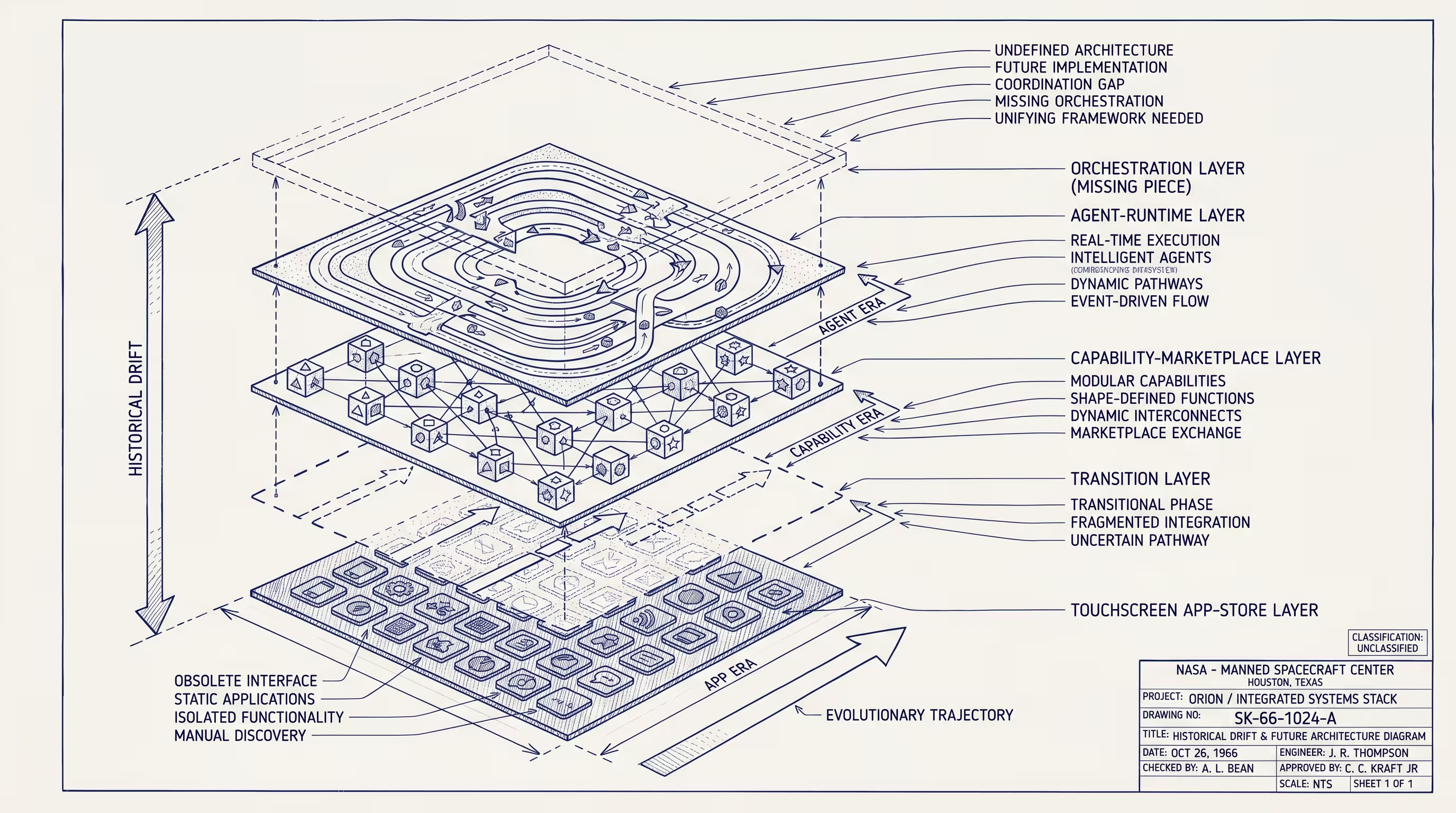
The app was a phase. We are in the late part of the phase. The next phase has a different shape, and the shape is starting to be visible enough to sketch.
The app made sense for fifteen years for three reasons that all stopped being true in the same eighteen-month window. The first reason was that the touchscreen was the primary interface, and the touchscreen rewarded a tile-grid model where each tile was a discrete program with a discrete trigger gesture. The second was that the network connection between the device and the cloud was thin enough and slow enough that pushing computation into a local binary was a real performance optimization rather than a vestigial habit. The third was that the user was the operator: the user picked the app, opened the app, drove the app, closed the app. The user's attention was the runtime.
All three are gone. The touchscreen is being supplemented by voice, by ambient audio, by the camera-as-input, by the wearable, by the workspace surface that does not have a primary form factor. The network is fast enough that running computation on the device is a strange optimization rather than a default. And the user is no longer the operator. The user is the principal. The agent is the operator. The user delegates the work and the agent runs it on whatever runtime makes sense for the work, on whatever surface makes sense for the user's context.
When the operator changes from the user to the agent, the unit of distribution stops being the app. The app was the right unit when the user was the operator because the user had to install the thing, learn the thing, drive the thing, and decide when the thing was done. The agent does not need any of that. The agent needs a capability, an authorization to use the capability on the user's behalf, and a runtime willing to host the capability for as long as the agent needs it.
The capability is the new unit. It is smaller than an app and larger than an API call. It is the thing that lets you "book a flight" or "pay this contractor" or "schedule the dental appointment" or "find the cheapest equivalent of this prescription," with the boundary drawn at the level of the user's intent rather than at the level of the engineer's bundling decision.
The marketplace where capabilities are listed and ranked is not going to be the App Store. The App Store made sense because the user was the operator. A user reads listings, browses categories, evaluates ratings, makes a one-time purchase decision, downloads the binary. The agent does none of those things. The agent reads structured capability descriptors, evaluates them against the user's stated and inferred preferences, runs a quick negotiation across the candidates, picks one for the current task, and is willing to pick a different one for the next task without any switching cost the user has to feel.
The marketplace for capabilities is closer to a real-time auction layer than a catalog. The capability provider lists what they do, what they cost, what they guarantee, what data they require, and what they will return. The orchestration layer matches the capability to the agent's current need. The user never sees most of this. The user sees the outcome.
The orchestration layer is the part that does not exist yet. It is the missing piece, and the structural fight of the next five years is over who builds it. The shape of the fight is recognizable. It is the shape of every prior platform fight: an interface layer that is perceived as commodity now becomes the most valuable layer in the stack once the layers above and below stabilize. The browser was perceived as commodity in 1998. The mobile OS was perceived as commodity in 2006. The orchestration layer is being perceived as commodity in 2024 and 2025, and the perception is wrong in the same way the prior perceptions were wrong.
The candidates for the orchestration layer are visible. The frontier-lab agent runtimes (the ChatGPTs, the Claudes, the Geminis) are one candidate. The OS-level agent layers that Apple, Google, and Microsoft are building are another. The independent agent platforms running on top of the frontier-lab APIs are a third. The native-blockchain capability-marketplaces being built around stable settlement are a fourth, and the one that gets the least serious attention from the people who should be paying it the most.
The first three candidates have the same structural weakness. They want to be the orchestration layer and the capability provider at the same time. The frontier lab wants to ship its own first-party capabilities and have its agent runtime route to them by default. The OS vendor wants the same thing at the OS level. The independent platform wants to charge the capability provider for placement. None of them are credibly neutral, and none of them can become credibly neutral while their commercial model depends on extracting margin from the capability layer below them.
The fourth candidate, the native-blockchain capability marketplace, has a different structural shape. It does not extract margin from the capability layer because the marketplace itself is an open protocol. The capability provider lists their capability with a settlement contract attached. The orchestration agent finds the capability through a public discovery surface and pays through the settlement layer. There is no marketplace operator extracting placement fees, because the marketplace is not operated by anyone in particular. This is the structurally honest version of what an orchestration layer should look like, and it is being built right now in a register that the AI press is treating as a distraction and the crypto press is treating as inscrutable. Both readings are wrong.
I have been building agent-orchestration thin layers on top of frontier-lab APIs for most of the last year, and I have lost arguments with myself about which of these candidates wins. The blockchain version is the one I keep dismissing and coming back to. Every time I sketch the durability question — what happens to the orchestration layer when the frontier lab whose API you depend on changes its terms — the open-protocol answer is the only one that survives the sketch. I wish it weren't. The blockchain ecosystem is full of bad actors and worse code and I would rather not be writing this paragraph. The argument that holds is the argument that holds.
The objection deserves to be named anyway. The native-blockchain version has not yet shipped at scale. The frontier-lab version has shipped, has users, and has captured the imagination of the discourse. The OS-level versions have shipped recently and have the distribution to win on default-installation alone. By the operator-grade metric of "what is being used right now," the blockchain version is not in the conversation. By the structural-fit metric of "what shape will the eventual orchestration layer have," the blockchain version is the only candidate that does not collapse under its own commercial conflict of interest within five years of becoming load-bearing.
The honest forecast, which I am willing to make, is that the orchestration layer is going to be a hybrid for the first phase. The frontier-lab agents will route to first-party capabilities by default and to a discovery layer for the rest. The OS-level agents will do the same with their own first-party capabilities. The discovery layer they all route to, when their own first-party offering does not cover the user's intent, will increasingly be the open protocol layer rather than another commercial intermediary. The frontier labs will not love this; they will participate in it because the alternative is to push the user toward a competitor's first-party stack, and the open protocol gives them a route the user trusts more than they trust each other.
The capability is the unit. The agent is the operator. The orchestration layer is the missing piece. The marketplace is an open protocol with the labs and the OS vendors routing into it.
What this stack does to humans, in the long run, is the part that the next decade gets to discover and the part that this sketch is not pretending to forecast. The capabilities will compound. The capabilities that compound will be the ones that move the user up the Maslow stack rather than further into distraction. Some fraction of the platforms will pick the latter and capture short-term attention. The platforms that pick the former will be the ones that compound durable value, because the agent-mediated stack is finally the architecture that lets the platform be evaluated against what it actually does for the principal rather than what it extracts from them.
The post-app stack is closer than the consensus believes. The shape is sketchable. The fights about who builds the orchestration layer are starting now. The fight about whether the marketplace is open or operated is the more important fight. Most of the people in a position to influence the second fight do not yet realize that they are about to be in it.
—TJ