What the rental-car return process should look like.
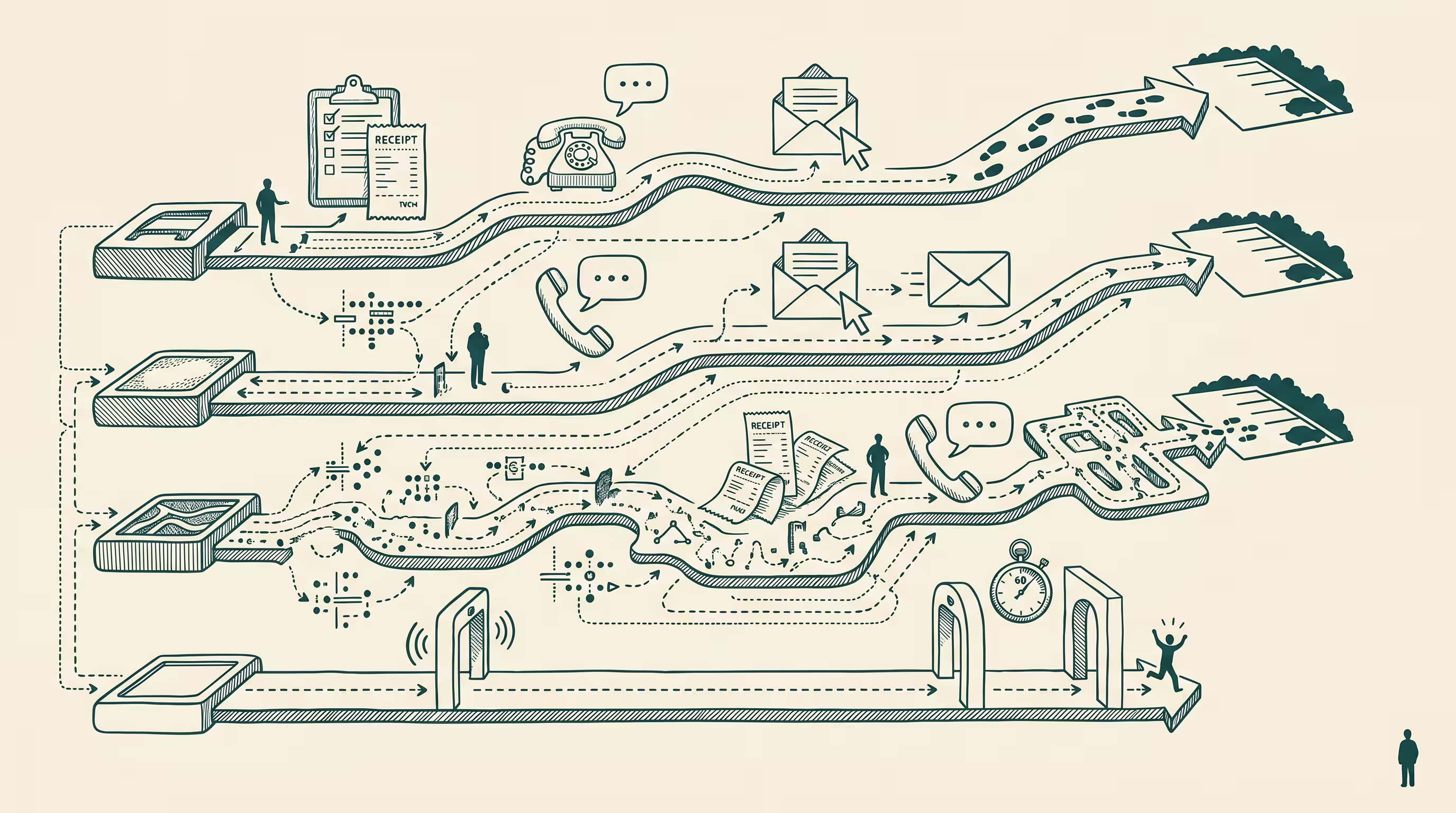
The rental-car return is one of the few remaining travel touchpoints where the operators have arrived at materially different answers and the variance is not a matter of taste. The right return ends in under sixty seconds with no human contact and no email follow-up. Exactly one operator has shipped it. The rest are running variants that re-introduce friction the variance was supposed to remove.
The right shape is the one National runs in the Emerald-Aisle-tier lots at the medium-to-large airports. The traveler drives into a numbered stall. A handheld scanner reads the plate or the QR sticker on the rear window. The handheld confirms the contract on a screen the traveler can see. The traveler walks. The receipt arrives at the email address on file before the traveler has reached the terminal door. There is no agent reciting the mileage back to the traveler. There is no upsell on the missing-fuel charge. There is no piece of paper. The traveler has been at the airport for sixty seconds longer than if they had walked in without a car.
The wrong shape (and there are several variants) re-introduces a service interaction the architecture was supposed to make redundant. Hertz at most airports asks the traveler to wait at the stall for an agent to arrive, which can take three to eight minutes during the morning return rush. Avis at the suburban locations runs a return that includes a printed receipt the traveler does not need and a final upsell question the traveler did not ask for. Budget and Payless run an Avis variant with worse training and longer queue times. Enterprise, which owns National, has the technology and chooses not to run it at the parent-brand counters because the parent-brand customer is presumed to want a service interaction. The presumption costs three to eight minutes per return and produces no measurable customer-satisfaction lift.
The reason National's return works is that the architecture treats the contract as the source of truth and the human as an exception path. The plate is the key. The system already knows the rental started, knows when, knows the agreed-upon mileage and fuel state, and knows where the credit card lives. The handheld scan is a reconciliation event, not a service event. If the reconciliation surfaces an exception (damage, fuel under a threshold, mileage way off the contracted band), the system raises the exception and routes the traveler to an agent. If the reconciliation is clean, the system closes the contract and the traveler walks. The agent's time is spent on the small fraction of returns that actually require human judgment. Every other variant inverts the ratio.
The intersection-with-AI question is whether the right return becomes more right when the reconciliation event is mediated by a model rather than by a deterministic rule engine. The answer is mostly no. The deterministic engine already handles the clean cases at the speed of a barcode scan. Adding a model in the loop slows the clean path down. Where the model earns its place is on the exception path: a model can look at a photograph of a possible fender scratch and decide, with calibrated confidence, whether the scratch was on the pre-rental walkaround or is new. That is a real workload and a model can do it cleaner than a human agent eyeballing the bumper at six in the morning. But that is a narrow piece of the return, not the return itself.
The lesson the other operators have not absorbed is that the return is a system-design question, not a customer-service question. The traveler who is returning a car at five-thirty in the morning does not want to be served. The traveler wants to leave. The operator that built the architecture to let them leave has a structural advantage on the segment of the market that drives the high-frequency revenue. The operators who keep the service-interaction frame in place are paying for the frame in agent payroll and in customer churn to the operator that doesn't.
The right return is sixty seconds and no contact. The variance from that benchmark is the operating-margin gap.
—TJ