Routing is the healthcare problem we should have solved first.
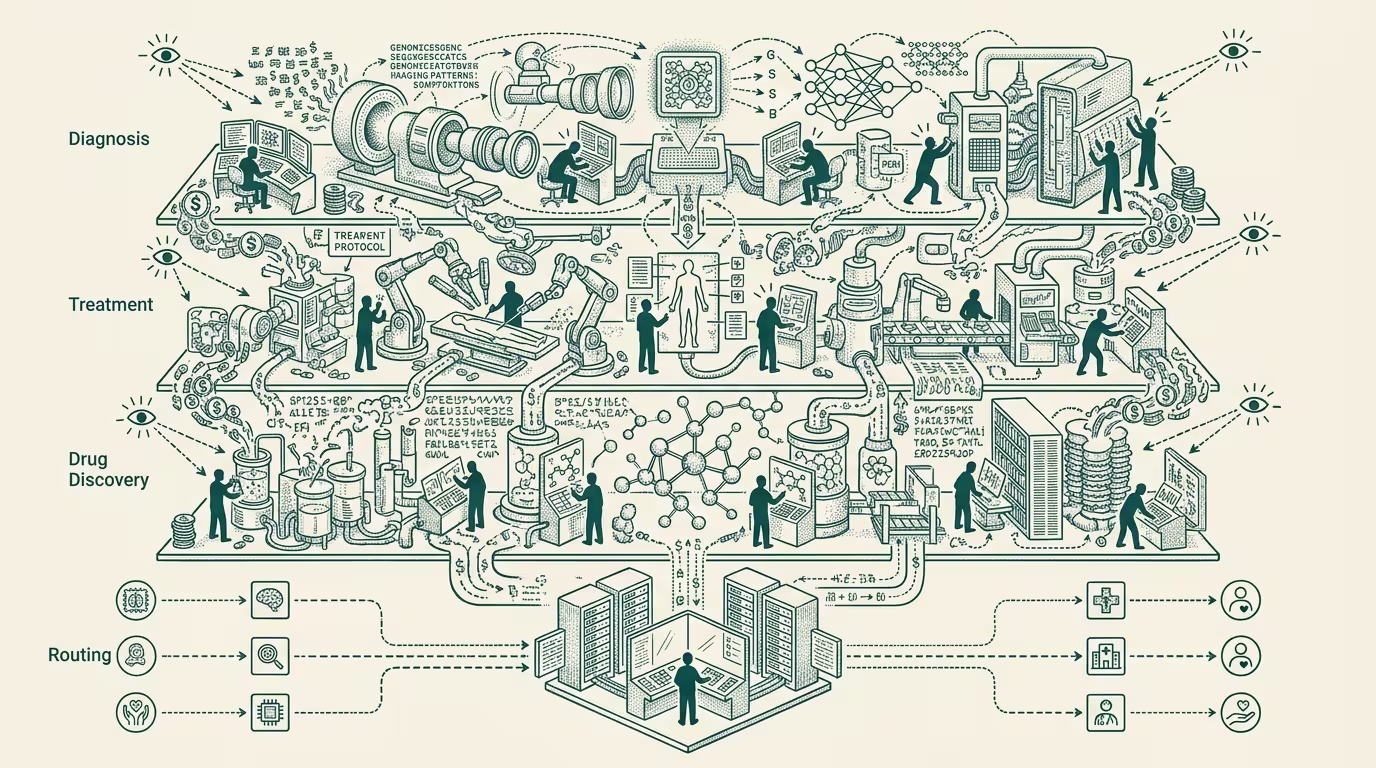
Six months ago, in a hotel bar in Las Vegas, I sat with a Canadian provincial-system executive who has been running a large piece of public health infrastructure for the better part of two decades. We had been at the same conference all week. It was the night before the closing keynote. The bar was the kind of bar that conferences inevitably produce, which is to say a bar that has been temporarily annexed by name badges, where the lighting is wrong for the conversations actually happening inside it. We were both holding drinks we had stopped drinking. He had been telling me, for about forty minutes, the same story I had been hearing in different versions all week, from people in different roles, in different jurisdictions, with different vocabularies, all converging on the same shape.
The shape was: we know what's broken. We have known for at least fifteen years. We can name it on a whiteboard. We have written reports about it, commissioned consulting decks about it, run pilots that confirmed it. The thing that's broken is not, primarily, the absence of doctors or the absence of beds or the absence of money, although all of those are real. The thing that's broken is upstream of all of those. It is the routing.
I remember thinking, on the flight back, that I had heard a version of this conversation in 2010. And in 2014. And in 2019, which was the last time I had been in a room of this density of healthcare operators. The conversation was the same conversation. The only thing that had changed, between 2010 and now, was that the people having the conversation had grown more tired. Not more pessimistic, exactly. More like the way a doctor sounds, late on a Friday, when they are still doing the work but have stopped expecting the system around them to help.
The week was HLTH, in Las Vegas, in October. I am writing this six months later because I needed those six months. The data I want to cite came out three weeks ago and confirmed, with the kind of specificity that only fielded survey work can give you, the thing the room had felt without saying it. I have been sitting with both (the room and the data) and the piece I want to write now is not the piece I would have written from the hotel bar.
What I mean by routing
I want to be precise about the word, because every healthcare conversation has a vocabulary problem, and routing is one of the worst-abused terms in the field. People mean different things by it. Some mean clinical decision-support, the layer that tells a clinician which test to order. Some mean care navigation in the consumer sense, the layer that tells a patient which clinic to go to. Some mean the back-office insurance routing that decides which plan pays for which line item.
I mean all of those, and one more, and the reason I mean all of them is that they are operationally the same problem.
The problem is: at the moment a person needs care, there is a question that has to be answered, and the question has a correct answer, and almost no one in the system is positioned to give it. The question takes different forms depending on who is asking. Where do I go right now? Who is the right person to see? Will this be covered, by whom, and what will I owe? How long will I wait if I take the obvious option, versus the non-obvious option two postal codes over? Am I in the kind of trouble that needs an emergency room, or the kind that needs a walk-in, or the kind that can wait until Monday?
These are routing questions. They are not, strictly speaking, clinical questions. The clinical question (what is wrong with me and what should be done about it) sits one layer in. The routing question is everything that has to be answered before the clinical question can even be asked of someone competent to answer it.
We built the entire modern healthcare system around the clinical question and treated the routing question as an administrative afterthought. That was the original sin. The clinical question, once you reach a clinician, has been studied, instrumented, and improved more or less continuously since the late 1800s. The routing question has been whatever the building's signage and the front-desk receptionist could manage between intake forms.
That worked, in the era it was designed for, because the routing problem was small. People had a family doctor. The family doctor was the routing layer. You called the office, the office told you where to go next, the office knew your history, the office's referrals went to specialists the office had a relationship with. The system worked because the routing was implicit in a relationship that almost everyone had and almost everyone kept for decades.
Almost no one has that relationship anymore. The routing layer is gone, and we did not replace it. We actually made it worse by allowing disparate medical institutions build their own websites (which are hard to find, hard to navigate, and don't talk to each other within the same jurisdiction), which gave rise to a myriad of online directories of various quality, or having people default into Google Maps, which is just as bad.
The supply-side problem we should also be honest about
I want to acknowledge the obvious objection before I go further, because the operator-reader is going to raise it.
The objection is: routing is a downstream symptom. The actual problem is supply. There aren't enough family doctors, there aren't enough specialists, there aren't enough beds, there aren't enough hours in the day for the clinicians we have. Fix supply and routing becomes easier; don't fix supply and the best routing layer in the world is just a more efficient way of finding out the appointment isn't available.
This is correct. It is also the conversation that has been happening, on rotation, since I first started paying attention to this sector in 2007. The supply-side answer is real, and it is a fifteen-year answer at minimum. Probably twenty.
The compounding causes are not mysterious. The post-pandemic burnout cohort that left clinical practice and has not returned. The compensation structure that makes family medicine the lowest-paid specialty in most provinces. The payment-model fights between fee-for-service and capitation that have stalled meaningful reform in three or four jurisdictions I can name without looking. The regulatory friction around interprovincial licensing that keeps a Manitoba physician from seeing a Saskatchewan patient by video without a separate license. The partial privatization debate, which is a real debate but has been used, on both sides, to delay every other reform that doesn't depend on resolving it. The entrenchment of provincial associations whose interests are not always patient interests. The political reality that healthcare is, in every jurisdiction I have worked in, a third-rail electoral issue where the cost of being wrong is higher than the cost of doing nothing. And the simple greed of every party in the chain, which is not unique to healthcare but is more visible here because the public expects better.
That is at least nine compounding causes. Each of them is worth a separate piece. None of them gets fixed in five years. The realistic supply-side timeline, if everything went right, is the better part of two decades.
This is the part operators in any other sector find hard to believe. An improvement that should take a month, in healthcare, takes a decade. An improvement that should take a year takes two. The patient-facing systems still in production today are running on assumptions that were already creaking when I looked at them in 2010, and the cycle time on replacing those assumptions has, if anything, gotten slower since.
The routing problem, by contrast, is solvable now.
Why the agentic layer changes the math
Here is where AI enters this. And here is where I have to be careful, because almost every version of this argument I have read in the past two years either overclaims and gets dismissed, or underclaims and changes nothing.
An AI system should not replace a clinician. A patient's medical questions should not be answered by a chatbot. The narrower thing that is true, and that the field has not yet metabolized, is that the routing question — the question of where to go, who to see, what is covered, how long the wait is, what the next step actually is — is a question the agentic layer is well-suited to answer, with appropriate scope and supervision, and that this changes the math on what is solvable on what timeline.
The supply-side answer is fifteen to twenty years. The agentic layer can also, over that same horizon, begin to relieve some of the pressure on supply directly (there are plausible roles where an agent operating with appropriate scope and supervision can absorb work that currently falls on a family doctor or a specialist) but that is a different essay, and I want to leave it to a different essay, because the case has to be made carefully and the case for routing does not depend on it.
The case for routing is simpler. The routing question requires bandwidth at the moment of need. It requires the ability to hold, in working memory, the patient's history, their insurance posture, the local supply landscape, the jurisdictional rules, and the time of day. It requires the ability to ask follow-up questions in plain language, in the language the patient actually speaks, at the literacy level the patient actually has. It requires the ability to do this for thousands of people simultaneously, at three in the morning, on a long weekend, in February, when no one is answering the phone.
This is the work the agentic layer can do. It is, in fact, the work the agentic layer is uniquely good at.
The data finally caught up with the room
Three weeks ago, the Pew Research Center published a study showing that 22% of U.S. adults now get health information from AI chatbots at least sometimes, with that figure rising to 32% among adults under 30 ([Pew Research Center, April 2026](https://www.pewresearch.org/science/2026/04/07/users-of-social-media-and-ai-chatbots-for-health-information-are-more-likely-to-say-they-are-convenient-than-accurate/)). The fieldwork was done in October, the same month I was at the conference. A separate study from West Health and Gallup, also published in April and also fielded last fall, found that 25% of U.S. adults had used AI for health information, and that 14% had skipped a provider visit because of the advice they got ([West Health-Gallup, April 2026](https://news.gallup.com/poll/707789/americans-turning-supplement-healthcare-visits.aspx)).
Two independent surveys, fielded in the same window, arriving at roughly the same number. That is what triangulation looks like.
The number is the under-30 number. Thirty-two percentof adults under 30 are already routing themselves through a chatbot, at least sometimes, for health information, in a system that has not authorized this behavior, has not trained for it, has not built for it, has not even fully acknowledged it is happening. The under-30 cohort is doing the routing themselves because no one else is doing it for them. Their family doctor, if they ever had one, is gone or retiring. The walk-in is a four-hour wait. The emergency room is an eight-hour wait. The phone tree at the provincial health line is a fifteen-minute hold to be told to go to the walk-in.
The data is six months behind the room. The room knew this in October. The data confirmed it in April. By the time you read this, both are old.
The regulatory shape that already exists
The regulatory work to enable this is not as exotic as the conversation often makes it sound. The shape exists. It exists in financial services. The UK's Open Banking framework, mandated by the Competition and Markets Authority, forced incumbent banks to expose customer-controlled data to authorized third parties, under a permission model the customer controlled, with security and audit requirements that the regulator defined. The Financial Conduct Authority's regulatory sandbox, running since 2016, gave fintechs a controlled environment to test consumer-facing products under modified regulatory burden. The Monetary Authority of Singapore did similar work on a faster timeline. None of this was perfect. All of it was directionally correct.
The healthcare equivalent is straightforward to describe and politically harder to do, but the political difficulty is not because the shape is unknown. The shape is: customer-controlled health data exposed to authorized third parties under a permission model the patient controls, with security and audit requirements the regulator defines, in a sandbox environment that lets new entrants test routing-layer products under modified regulatory burden, with the data-protection regime (PHIPA in Ontario, HIPAA in the United States) held strictly intact.
The political difficulty is not the regulation. The political difficulty is the incumbents. This is also true in financial services. It was true in financial services. Open Banking happened anyway, because the regulator was willing to do it.
What I want from a minister of health, in any jurisdiction reading this, is the same thing the FCA was willing to do, but ten times faster, and in healthcare. The window in which this can be done before the under-30 cohort routes itself entirely outside the system is narrower than the political clock most ministries operate on.
The investor paragraph, briefly
I will keep this short, because investors who care about this sector already know the shape and investors who don't will not be persuaded by a paragraph.
The unit economics of a routing-layer product are unusual. The B2C side is what acquires the user: the patient comes to you because they need to find care, right now. The B2B2C side is what monetizes: the system pays you because you are reducing inappropriate emergency-room visits, surfacing earlier intervention, routing patients into the highest-leverage available appointment slot. The bridge between the two is trust, and trust is the gating constraint on the entire category. Trust is built by being correct on routing, repeatedly, in the visible cases the patient can verify. Trust is destroyed by being incorrect on routing, once, in a high-stakes case the press picks up. The asymmetry is severe. The companies that win this category will be the ones that internalize the asymmetry from day one and design their scope accordingly.
That is the investor paragraph. The rest is execution.
What this looks like for the rest of us
I want to close on the part most of the people reading this will recognize from their own lives, because this is not a sector essay only. This is a public-life essay.
You probably know someone who has waited over a day in an emergency room. Not a hyperbolic day — a literal one, a stretcher-in-the-hallway day, a sandwich-from-a-vending-machine day. You probably know someone who has lost their family doctor in the past three years and has been on a registry list since, with a wait time measured in calendar years, not months. You probably know someone who has driven a parent to a clinic in another province (or abroad) because that was, on balance, faster than the closest available option in their own.
You probably know all of those people. Some of them are you.
The system as designed has a routing layer that no longer exists. The supply-side answer to that is real and is fifteen to twenty years away. The agentic-layer answer is real and is available now, with appropriate scope and supervision, if the regulatory shape allows it.
Push the system to allow it. Push your provincial health minister to allow it. Push your federal counterpart to allow it. Push the regulators to look at Open Banking and copy what worked. Push the incumbent associations to remember that their members became clinicians to take care of people, and that the routing problem is killing the people their members are trying to take care of.
There are solutions. They are not exotic. They are not science fiction. They are sitting in the same shape that financial services adopted ten years ago, waiting for someone in a position to act to act.
The room in the hotel bar knew this in October. The data knew it three weeks ago. The next twelve months will determine whether the system gets to know it in time to do anything about it, or whether the under-30 cohort, who already know, just route around the system entirely and never come back.
I would prefer the first outcome. I am not, having watched this for fifteen years, betting on it. But I am, having watched what the agentic layer is capable of from the operator's side for the past two years, more hopeful than I have been at any point since I started paying attention.