SkyMiles devalued and the DOT showed up. Loyalty is a regulated product now.
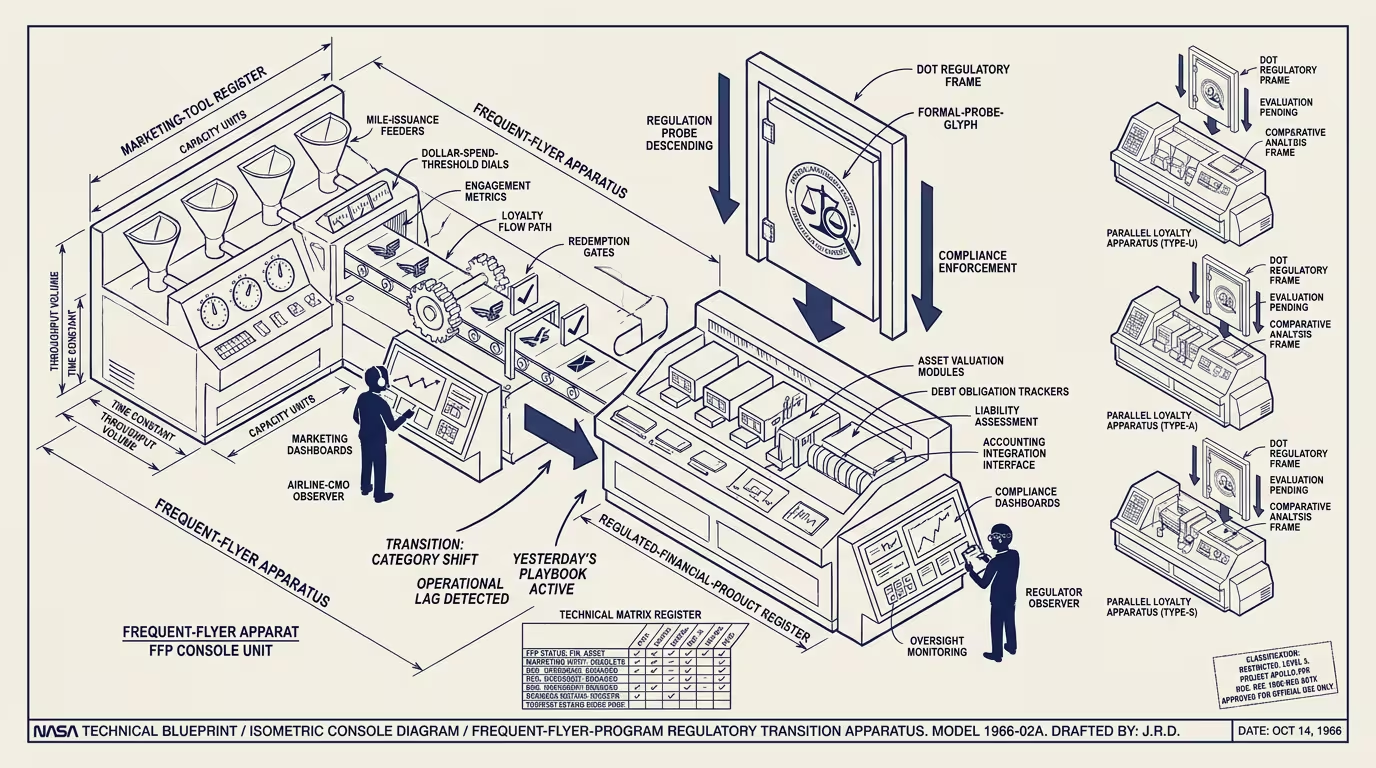
The frequent flyer program is no longer a marketing program. It is a regulated financial product, and most of the airline executives running their loyalty programs in mid-2024 are still treating it as the marketing program it used to be.
The September 2023 SkyMiles overhaul was the first signal. Delta announced sweeping changes to the qualification structure: dollar-spend thresholds higher, mile-earning weighted to credit-card spend rather than flight activity, status revenue requirements significantly elevated. The backlash was operator-class loud. Frequent flyers wrote thousands of complaint letters. The trade press wrote it up. Travel-blog ecosystem (View From The Wing, One Mile At A Time, The Points Guy) ran the math and showed the practical effect: median elite-status traveler at Delta would be losing access. Within weeks CEO Ed Bastian publicly admitted the airline had moved "too far, too fast" and walked back parts of the announcement.
The walk-back was not the lesson the airline took. United, American, and Southwest watched Delta absorb the customer backlash and concluded that the customers who screamed were not the customers paying the bills. Through 2024 each of them announced their own devaluations on similar themes, each calibrated to be incrementally less aggressive than the next, each absorbing customer complaints that were less acute because the precedent had been set. The category-wide repricing of frequent flyer programs was, by mid-2024, in motion.
What the airlines did not anticipate was that the Department of Transportation was watching.
On September 5, 2024, the DOT formally opened a probe of the four largest carriers' loyalty programs. The probe asked, among other questions, whether the programs constituted a financial product subject to consumer-protection regulation, whether the carriers had adequate disclosure of devaluation risk to their members, and whether the programs' approximately $20 billion in annual revenue (some industry analyses put the FFP revenue ahead of the airlines' actual flight-operation revenue) made them a regulated category by structural analogy to other consumer-finance products.
That probe was the structural shift.
Up to that point the frequent flyer program had been treated, by the airlines and by the regulators alike, as a marketing program. A marketing program can be devalued unilaterally because the program is, in legal terms, a discretionary benefit the airline offers its customers. A regulated financial product cannot be devalued unilaterally without disclosure-and-process. The DOT probe did not declare the FFP a regulated product. The probe asked whether it should be. That question, asked at the federal level on a probe that the four major carriers had to respond to in writing, changed the operating context.
The interesting thing about the timing is that the DOT probe coincided with the AAdvantage Business launch by American (which was, of course, a parallel attempt to use loyalty mechanics to do an end-run around travel-agent distribution rules) and with United's first announcement of post-Delta devaluations. The probe's framing was that loyalty programs were being used as a financial-leverage mechanism rather than as the marketing-loyalty mechanism they were originally designed as. That framing, once it hit the federal record, was hard to walk back.
The part that holds for the airlines is that every loyalty-program decision from Q3 2024 forward has to be priced against the regulatory horizon. The airline that moved aggressively in 2023-2024 captured short-term financial gain. The airline that moves aggressively in 2025 may be doing it under disclosure-and-comment-period rules that the airline cannot easily price into the next round of changes. The structural shift is the cost-of-future-flexibility. Operators who burned that flexibility in 2023-2024 may have been making a short-term-correct decision that priced poorly against the regulatory horizon they did not see coming.
The part that holds for travel buyers is sharper. The corporate buyer of FFP earnings (the corporate travel manager who negotiates with the airline on volume) now has a regulatory cudgel they did not have in 2023. If the airline devalues the corporate-card-earning structure unilaterally, the buyer can plausibly cite the DOT probe in the negotiating room. The negotiating leverage shifted slightly toward the corporate buyer. Most corporate buyers will not, of course, know to use it.
The part that holds for the points-and-miles ecosystem (the Chase, Amex, Citi credit-card programs that account for a meaningful fraction of FFP earning) is the most consequential. Those banks are sitting on, in aggregate, hundreds of billions of dollars of points liability on their balance sheets. They have, until now, treated that liability as a marketing-cost expense category. If the FFP becomes a regulated financial product, the banks' accounting treatment of the points liability changes. The reserve requirement may change. The disclosure regime around points-redemption-risk may change. The ecosystem of card-and-airline-partner deals that make the points-and-miles industry profitable may have to be repapered. None of that is happening yet in 2024. All of it is, of course, on the horizon.
The honest summary is that the FFP became a regulated product on September 5, 2024, even though the regulation has not yet shipped. Once a federal probe is open, operators in the category have to assume the regulatory horizon is going to price into every future decision, and the operating cost of unilateral devaluation just went up. The airlines that move aggressively from this point forward are doing it knowing the regulator is watching, knowing the trade press is documenting it, and knowing the corporate buyer's negotiating leverage just changed. The airline that figures this out first wins the next category cycle. The airline that treats the FFP as a marketing program well into 2025 is the airline that gets to test the regulatory response, of course, on its own balance sheet.
—TJ