Spirit asked for a bailout. Nobody legislated 'no'.
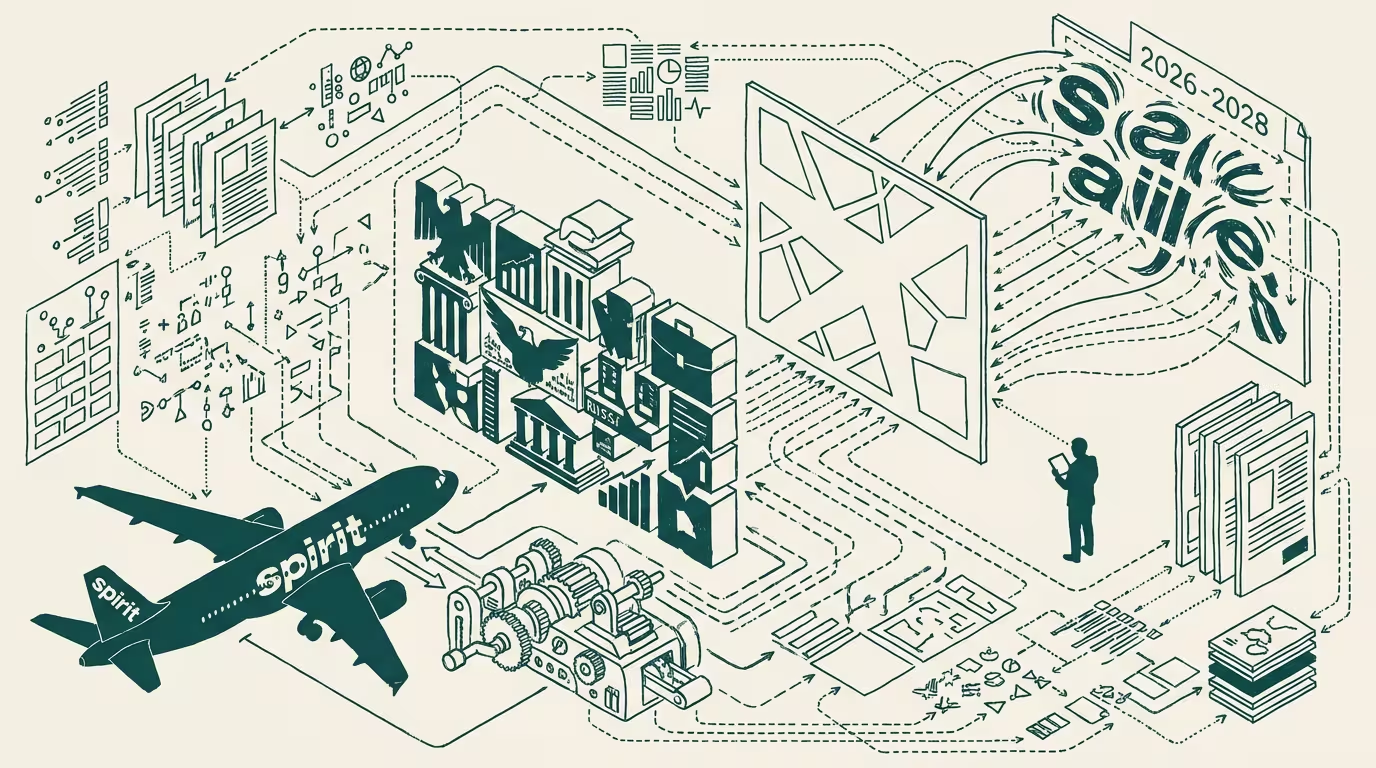
Through March and April 2026, Spirit Airlines was in negotiations with the Trump administration for a roughly $500M bailout. The proposed structure would have given the U.S. government a majority equity position in exchange for the cash injection. The bipartisan opposition that emerged within ten days of the proposal becoming public — Senator Cruz on the right, Mike Pence's policy network, the WSJ editorial board, every other major U.S. airline — blocked the deal. By late April, Spirit had withdrawn the bailout request.
The trade press wrote up the bailout-failure as a Spirit story. The durable read is broader.
The absence of a bailout was the structural signal. _Fourteen years of post-COVID aviation policy — the CARES Act precedent, the Airline Worker Support Program, the Payroll Support Program extensions through 2021 — had quietly accumulated into an industry expectation that the federal government would catch falling carriers._ The Spirit bailout-block was the moment that expectation legibly broke. The next ULCC(ultra-low-cost-carrier) restructuring will be priced without a federal floor.
The mechanism is in the test conditions. The post-COVID aviation-policy regime treated airlines as critical infrastructure deserving of federal financial support during demand shocks. The 2020-2021 federal aid package totaled approximately $54B across airlines, supporting payroll and preventing mass layoffs. The precedent that emerged was that any major demand shock would trigger a similar federal response. Spirit's 2026 bailout request tested that precedent against a non-demand-shock context — the carrier's distress was structural (failed merger with JetBlue blocked by DOJ in 2024, ongoing fleet-cap pressure, ULCC margin compression) rather than demand-shock-driven. The political class declined to extend the precedent.
What does the next ULCC restructuring look like? Priced without a federal floor. Frontier, Allegiant, Sun Country, and the long tail of regional ULCCs operate against a structurally different set of assumptions in 2026 than they did in 2024. The federal-floor expectation that backstopped ULCC equity through 2025 is, post-Spirit, no longer operating. The investor-class repricing that follows is calibrated to a higher distress-resolution risk. ULCC equity premiums compress. The category's cost-of-capital rises. The operator-class question for ULCC executives is whether the cost-of-capital rise is absorbable through operating improvements or whether it's terminal for the category's growth thesis.
What's shifted in the political-economy frame? Through 2020-2024 the political consensus on aviation was bipartisan-pro-bailout. By 2026 the political consensus is bipartisan-skeptical-of-bailouts for non-shock distress. The shift is durable through at least the 2026 election cycle and likely longer. Operators in adjacent regulated industries (regional rail, intercity bus, commercial-shipping, regional-utility) reading the Spirit precedent should expect similar political-economy shifts in their own regulated-bailout expectations. The post-COVID expectation regime is, in 2026, structurally different from the pre-2026 regime.
What signal did the legacy carriers send? Capacity-rationalization preference. Every other major U.S. airline opposed the bailout. The opposition was framed publicly as anti-government-equity ideology and operationally as competitive-position protection. Both framings are correct. The operator-level read is that legacy carriers actively prefer ULCC distress to ULCC continued-operation under federal-floor protection. The post-Spirit market structure, with reduced ULCC capacity, advantages legacy carriers' yield-management and slot-position economics. The opposition was, in operating terms, a coordinated capacity-rationalization play.
The thing that crosses pillars is that the bailout-precedent breaking has effects beyond aviation. Any industry that built operating assumptions around federal-bailout availability — banking, automotive, agricultural-commodity, regional-energy — has to recalibrate the assumption set against the post-Spirit precedent. The recalibration is industry-by-industry and depends on each industry's specific political-economy position. Aviation's position was, in 2020-2024, the strongest of the bailout-eligible industries. The Spirit-precedent break is therefore the leading indicator for similar precedent-breaks across other industries' bailout-expectations.
What survives all of this is that Spirit's bailout-failure is one of the cleaner political-economy markers of the post-COVID regime breaking, the operator repricing of ULCC equity that follows is durable, and the cross-industry implication is that bailout-expectation regimes are structurally more vulnerable in 2026 than the operator class generally assumed. Operators running plans with implicit bailout-expectation assumptions should run the assumption-set explicitly against the post-Spirit precedent.
Spirit asked for a bailout. Nobody legislated 'no'. The absence of legislation was the signal. The federal floor that operators had been pricing in is, in operating terms, gone. The category's next restructuring will be priced against the new floor — which is, in operating practice, no floor at all.
—TJ