The post-Stack Overflow developer exists.
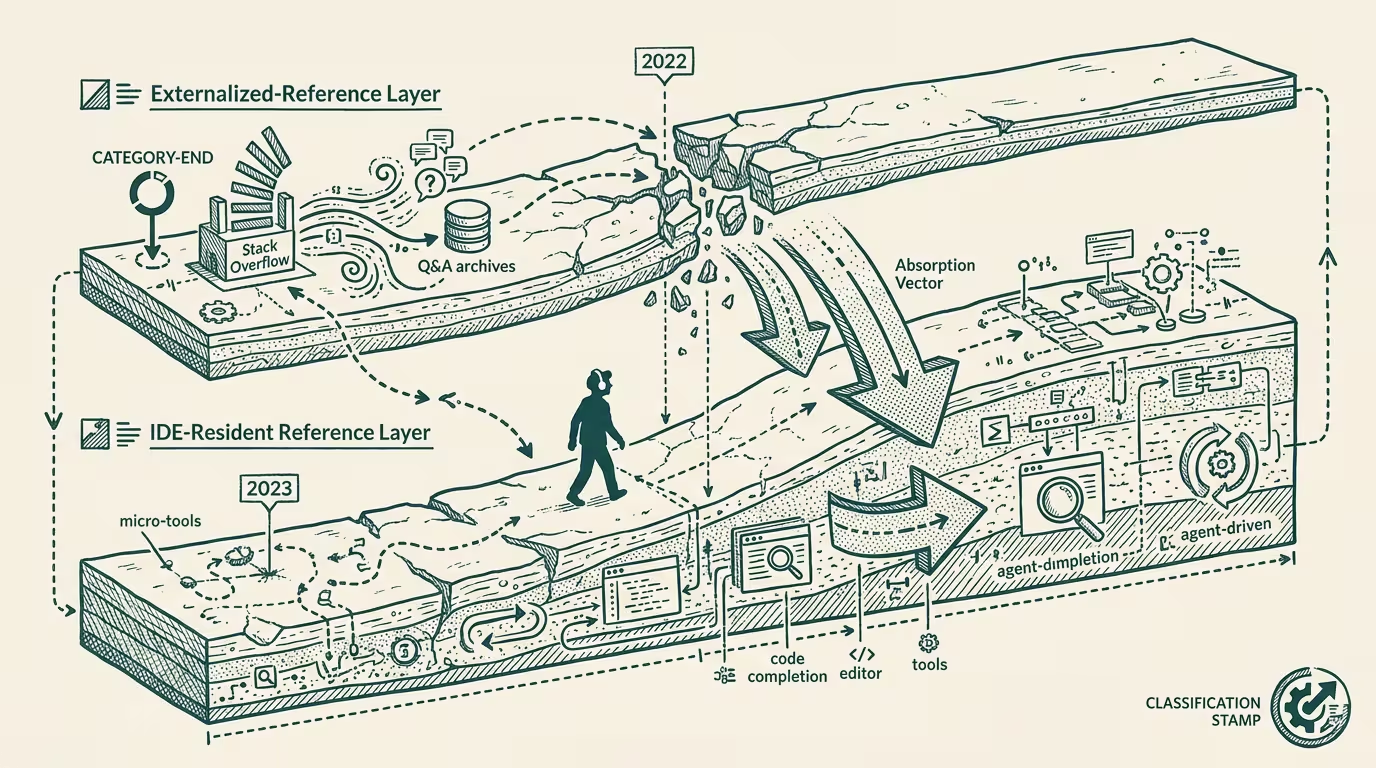
Stack Overflow's traffic dropped by roughly 35% across 2024. The decline started in late 2022 with the first GPT-3.5 inflection. It accelerated through 2023 with Copilot adoption. It compounded through 2024 with Cursor and Claude Code crossing into the developer mainstream. By Q3 2024 the question that used to be typed into Stack Overflow's search box was being typed into an agent's chat window or, increasingly, not typed at all because the agent surfaced the answer before the developer formulated the question.
The site is not dying. The category is. Stack Overflow was the externalized reference layer for a generation of developers, and that layer is being absorbed into the IDE.
What that means for a developer learning to code in 2024 is that the practice of _asking another human for help_ is no longer load-bearing in the developer's daily workflow.
That is the structural shift this piece is naming. _The next-generation developer learns from agents, not from peers._
The implications run sharper than the trade-press read.
The trade-press version of this story is "AI replaces Stack Overflow." That framing misses the load-bearing thing. Stack Overflow was not just an answer-engine; it was a _training environment for the practice of articulating a technical problem to another developer_. To get a useful answer on Stack Overflow, the developer had to write the question well. They had to identify what they had tried, what they expected, what actually happened. They had to provide a minimal reproducible example. They had to read other answers, see what worked and what didn't, and synthesize. The Stack Overflow question-writing practice was, for fifteen years, _the implicit curriculum_ by which junior developers learned to think about engineering problems in a way that other engineers could engage with.
The agent does not require that practice. The agent will accept a vague question, will iterate against the developer's vibes, will provide an answer the developer can paste, and will never push back on the formulation. The developer who learns to code in 2024 by working with Cursor never builds the articulation practice the Stack Overflow generation built.
That has consequences at the senior-engineering layer.
Senior engineering, in any organization larger than five people, is half technical-judgment and half _the practice of articulating technical decisions to other engineers_. The senior engineer has to write design docs. The senior engineer has to lead reviews. The senior engineer has to disagree-and-defend in cross-team conversations about architecture. The senior engineer has to mentor juniors by asking the juniors to articulate the problem they think they have, not by handing them the answer.
Each of those is downstream of the same skill the Stack Overflow generation built implicitly: _the ability to formulate a technical problem in a form another human engineer can engage with_.
The post-Stack Overflow developer, on the available evidence by late 2024, has not built that skill at the same level. The early data from the engineering-hiring market shows it. Senior-engineer candidates with 3-5 years of experience trained primarily through agent-mediated learning (the cohort that started learning in 2022-2023 and is now showing up in mid-level pipelines) demonstrate, on coding tasks, comparable or superior raw productivity. They demonstrate, on design-doc-writing and technical-disagreement tasks, materially weaker performance. They have built the productivity skill the agent rewards. They have not built the articulation skill the agent does not require.
That is the load-bearing implication.
Senior engineering hiring in 2026-2030 is going to face a structurally smaller pool of candidates who can do the half of the senior job that is articulation. The candidates who can do _both_ halves will be a scarce commodity. They will command a premium that is materially larger than the current senior-vs-mid-level salary gap. The hiring market is going to bifurcate: a productivity-tier of agent-trained engineers who can ship code at high speed, and a smaller architecture-tier of engineers who can do the design-and-articulate work that the productivity tier cannot.
This bifurcation is, of course, not fully visible yet in 2024. The cohort that learned post-Stack-Overflow is still in the early years of their careers. The senior-engineering hiring squeeze does not show up at scale until 2027-2030, when the cohort that should be senior-tier instead is missing the articulation practice.
What does the operator-class company do about this?
Three responses, all of which require explicit investment.
One. Treat technical-articulation as a trainable skill and train it explicitly. Stack Overflow trained it implicitly. The post-Stack-Overflow developer needs an explicit training regime. Internal design-doc programs. Internal architecture-review practices that require the junior to articulate before the senior responds. Internal coaching on technical writing. The companies that build this internal training apparatus produce senior engineers in 2028-2030 that the companies that don't, can't.
Two. Hire for the articulation skill at junior level, even if it costs more on the productivity dimension. The junior with strong articulation and weaker raw productivity becomes the senior the company needs in five years. The junior with strong raw productivity and weak articulation becomes the productivity-tier engineer who plateaus at the mid-level layer. Both are valuable. The company that hires only for raw productivity discovers, in five years, that they have no architecture-tier candidates internal to promote.
Three. Build internal practices that _require_ articulation before the agent answers. The dev-tool that makes the engineer write the design rationale before the AI writes the code. The internal review process that requires the engineer to articulate the problem before the agent writes the solution. The cultural norm that the agent is the second draft, not the first. These practices are the articulation-training-on-the-job equivalent of what Stack Overflow used to do passively.
The opportunity for an enterprising tooling company is to build the dev-tool that _makes_ articulation load-bearing in the developer's daily flow. The current generation of agent-coding tools does not do this. The next generation will. Whoever builds it sells into every engineering org that has noticed the senior-pipeline gap forming.
thing that crosses pillars is sharper. Stack Overflow was the externalized peer-learning layer for software engineering. _Other professions had their own versions._ Doctors had textbooks and rounds. Lawyers had precedent searches and partner reviews. Consultants had the case-study library and the senior-partner-debrief. In every case, the externalized peer-learning layer is being absorbed into agent-mediated workflows. The same articulation-skill-erosion is going to play out in every knowledge profession on a 5-10 year curve. Software engineering is the leading indicator because it had the cleanest externalized layer (Stack Overflow) and the fastest agent-replacement curve.
The post-Stack Overflow developer exists. The post-textbook doctor is a few years behind. The post-precedent-search lawyer is behind that. Every knowledge profession is going to face the same senior-pipeline problem, on its own timeline, and the operators who recognize the pattern early get to build the institutional response before the bottleneck lands.
Stack Overflow's traffic decline is the visible signal. The structural shift is the developer's relationship to peers. The senior pipeline is the load-bearing variable. The companies that recognize this in 2024 are the companies producing the senior engineers of 2030.
The articulation practice is the moat. _The agent does not enforce it. The operator has to._
—TJ