Vibe coding was real. The walkback is the lesson.
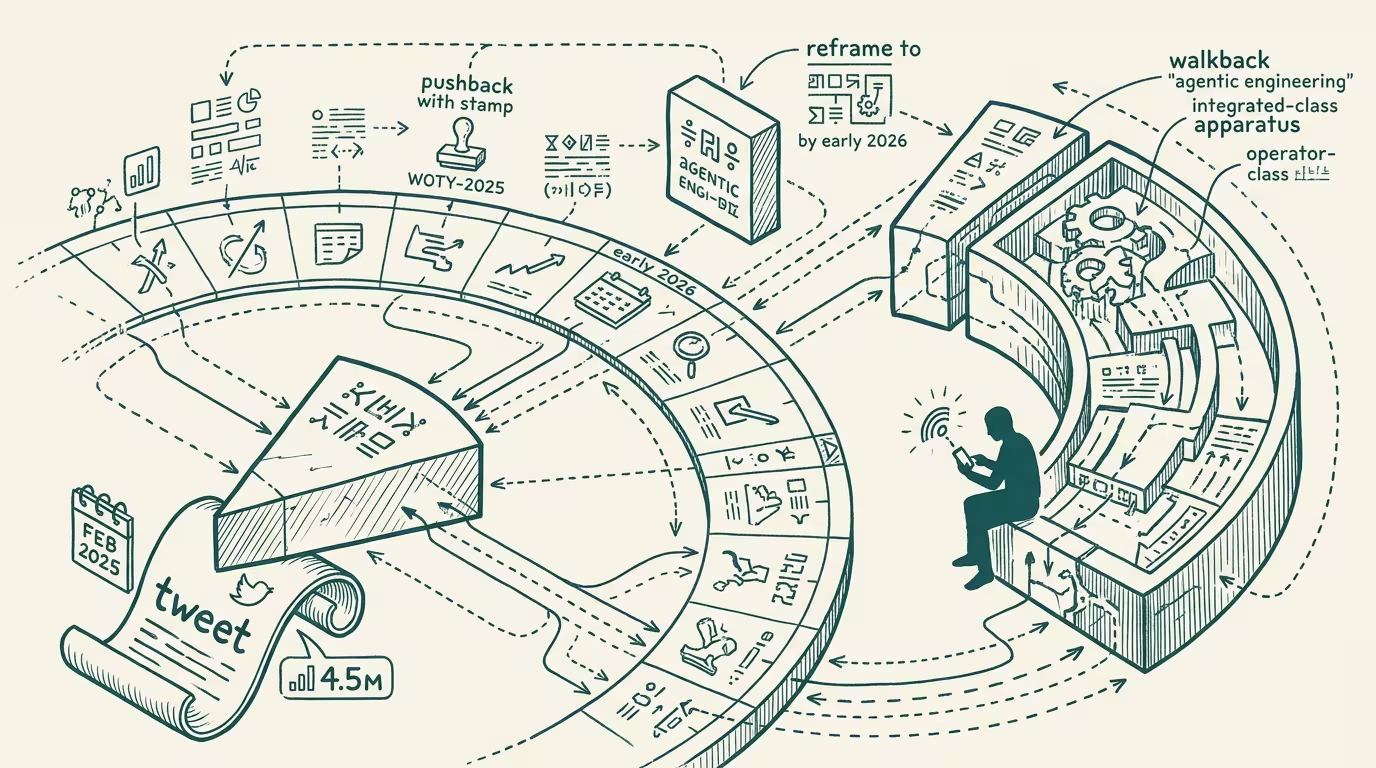
Andrej Karpathy posted what he called a "shower of thoughts" on February 2, 2025. The phrase that landed was "vibe coding" — a mode where the developer "gives in to the vibes" and lets the LLM write code without close review. The tweet hit 4.5 million views inside seventy-two hours. Andrew Ng pushed back within the week. Collins named it Word of the Year for 2025. By early 2026, Karpathy himself had reframed the practice as "agentic engineering."
The reframing is the actual operator lesson. The arc tells the story of how a wedge term gets walked back into a workflow term, and the walkback is where the operator-class signal lives.
The wedge — vibe coding as a mode the developer chooses — got the practitioner class to engage with the new mode of work. It named something practitioners were doing. The naming was correct. The framing was the part that had to walk back, because letting the LLM write code without review is a workflow that breaks at scale. "Give in to the vibes" implies the developer has stopped doing review. _The developer has not, in operating practice, stopped doing review — the developer has shifted what review looks like._ The review now happens at the test-suite level, at the type-checker level, at the integration-test level, at the production-monitoring level. The reviewer is still the developer; the unit being reviewed is no longer a function but a working system. That is what agentic engineering names. It is the workflow that survives at scale.
The receipts that drove the walkback arrived through 2025. By Q3 the vibe-coding framing was carrying weight it could not bear. Tech-leads at midsize companies were reporting that junior developers were committing LLM-generated code without review, breaking production, and citing vibe-coding as the rationale. The framing had jumped the technical-discourse gap into the management-class lexicon, and management-class adoption flattened the nuance. By December 2025 the trade press was running "vibe coding broke our codebase" pieces with regular cadence. The reframing to agentic engineering is, in operating terms, the discipline retreat. The discipline says: the developer is still in the loop, the review is still happening, the loop is just at a different layer. That framing scales. The vibe-coding framing did not.
The workflow term is what survives the walkback. Karpathy did not reframe to agentic engineering because the original framing was wrong on the technical merits. He reframed because the failure receipts (broken codebases, production outages, junior-developer trust collapse) were public enough that the framing needed to retreat. The walkback is, in operating terms, the moment the discourse-leader reads the receipts. The receipts always arrive. The question is whether the operator's plan was calibrated to the wedge term or to the workflow term. Operators calibrated to the workflow term are operating coherent through the walkback. Operators calibrated to the wedge term have to recalibrate publicly, which costs them.
What the wedge-vs-workflow shape teaches operators is that the wedge term is not the workflow term. Wedge terms are correct at the inception of a category and wrong as the category matures. Operators tracking AI-coding workflows should watch for the wedge-to-workflow term shift in adjacent categories (AI-design, AI-research, AI-customer-support, AI-clinical-decision-support). Each will have its own wedge term and its own walkback. The walkback is the lesson, not the wedge.
What the management-class flattening teaches operators is that the management-class adoption breaks the practitioner-class nuance. Vibe coding was nuanced when Karpathy named it. By the time the term reached middle-management discourse, the nuance was gone. The "give in to the vibes" framing was being applied as policy by managers who did not write code. The result was operating-bad. The same dynamic recurs across AI-discourse-to-management adoption cycles: wedge terms that are correct at the practitioner layer get flattened at the management layer. Operators have to either coin the workflow term early or let the management class default to the wedge term and absorb the cost.
The same shape recurs across AI-deployment categories generally. Healthcare-AI is in the middle of a similar arc with "AI assists doctors" (the wedge term, correct at the methodology layer, wrong at the deployment layer where physician-trust calibration is doing the work). Travel-AI is in a similar arc with "AI books the trip" (correct at the consumer-research layer, wrong at the actual-purchase layer where the OTA's checkout flow does the work). Each category has its own wedge term, its own walkback, and its own workflow term that survives the walkback.
What survives all of this is that vibe coding was real, the walkback was inevitable, and the workflow term that emerged from the walkback (agentic engineering) is the term operators should be calibrating to in 2026. The trade press will, of course, continue to use both terms interchangeably for another eighteen months. The discipline is to use agentic engineering when the workflow is the subject and vibe coding when the cultural-moment is the subject. The two terms are not synonyms. The first is operating-relevant. The second is, in late 2025 and into 2026, mostly residual from the wedge.
Karpathy named both terms. The second term is the one that survives. The lesson is the walkback, not the original tweet.
—TJ