What the open-weights community actually shipped in 2025.
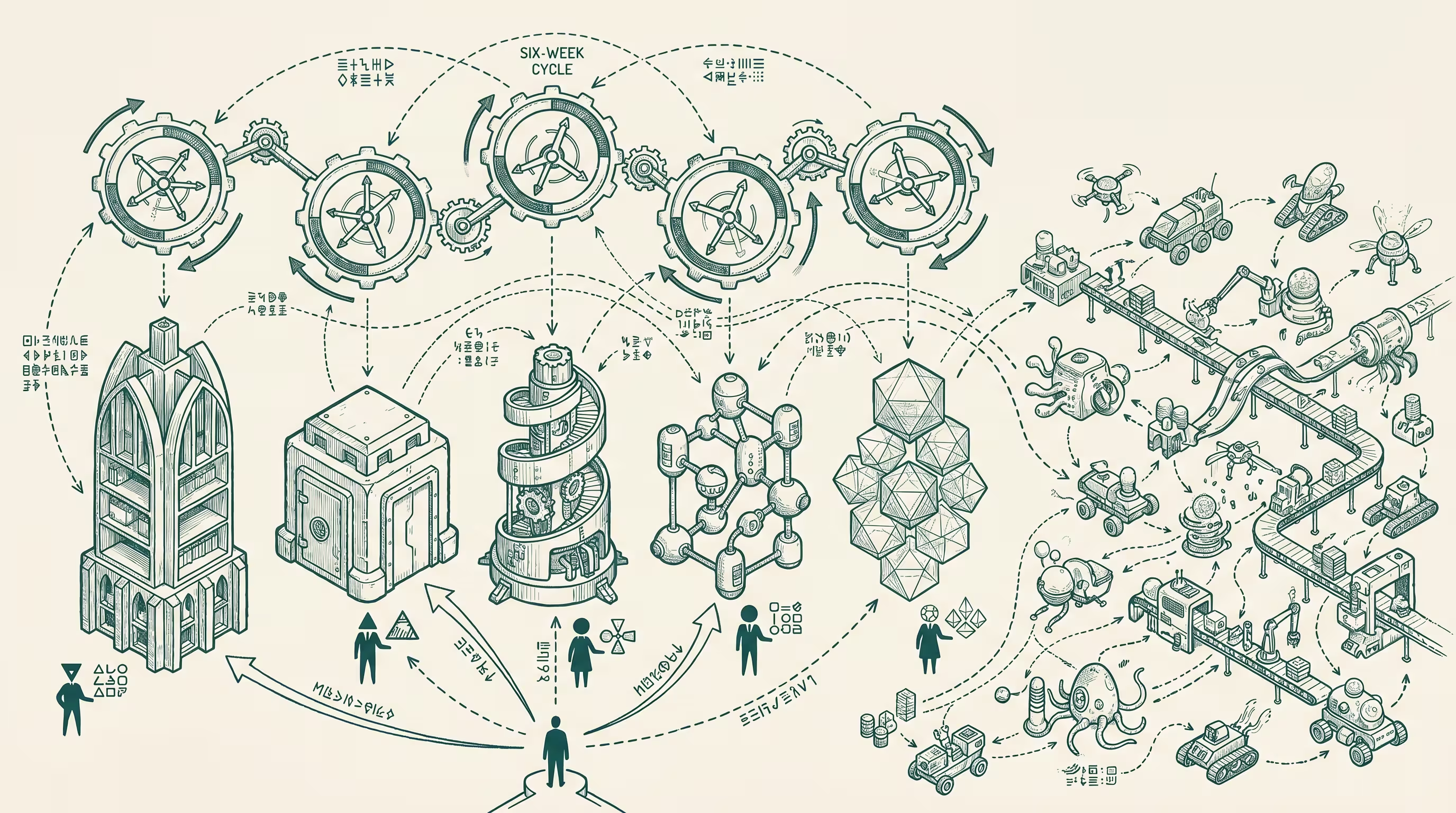
The open-weights story in 2025 is not the story the leaderboards told. The benchmark numbers compressed into a narrow band where Llama, Mistral, Qwen, and the long-tail traded the top slot every six weeks, and the discourse focused on the trades. The interesting story is what held up under load. Five releases mattered for production workloads in 2025, three of them for reasons that were not visible on any benchmark, and the long-tail of specialist models did more real work than the headline generalist releases.
This is an end-of-year inventory written from the operator side rather than the leaderboard side. The question is not which open-weight model has the highest MMLU or the highest Arena ELO. The question is which models, having been put into a production stack with real latency budgets and real cost ceilings and real failure modes, kept getting renewed in the quarterly stack-review meeting. That is a different filter and it produces a different list.
The five releases that mattered
Llama 4. The mid-2025 Meta release was the one that most changed how teams thought about the cost-per-good-output curve at the high end. The 70-billion-parameter checkpoint hit a quality band that had been the exclusive territory of the closed labs eighteen months earlier, and it did so with a license that let teams fine-tune and deploy without a per-call payment to a vendor. The licensing terms still excluded use as a foundation for hosted competing services, and teams paying close attention noticed the carve-out, but for the dominant pattern (fine-tune on private data, deploy in private infrastructure, serve internal users), the license was clean. The teams that moved to Llama 4 from their late-2024 Llama 3 baseline saw a measurable lift in the kinds of tasks where the prior generation was failing in narrow but recurring ways: long-form summarization where the prior model would forget the through-line at the half-document mark, multi-step reasoning where the prior model would lose the thread on the third hop, code generation where the prior model had a calibrated edit but a mis-calibrated root-cause diagnosis. The lift was modest on benchmarks and substantial on production workloads, which is the spread that matters.
Qwen 3. Alibaba's late-2025 release is the one that made the math for non-English workloads work. The Qwen lineage had been quietly competitive for a year, and the public discourse had not caught up because the Western evaluators kept benchmarking on English-language tasks where Qwen's gap was not its strongest feature. On Mandarin, Cantonese, and Korean workloads, Qwen 3 was not competitive. It was the obvious right answer, by a margin that did not exist on the English leaderboards. Teams running global products with material non-English traffic moved their non-English routing to Qwen 3 and kept their English routing on Llama 4, which produced the year's most common production architecture: a router in front, a Llama-4 path for one set of languages, a Qwen-3 path for another, and a quality monitor watching for the cases where the router made the wrong call. That architecture would have read as exotic in 2023; in 2025 it was the dominant pattern for any workload above a certain global-traffic threshold.
Mistral Medium and Mistral Large 3. Mistral's pair of releases in spring and fall 2025 occupied the niche the discourse kept calling "small but very good." The Medium model in particular hit a price-and-latency point where teams that had been running closed-API calls for low-stakes routing tasks could move the routing to self-hosted Mistral and recover materially on cost without losing on quality. The Large 3 model was a more expensive cousin that competed directly with Llama 4 on quality, sometimes won, sometimes lost, and was the model teams chose when the licensing terms on Llama 4 were the friction. In production, Mistral's stack felt more like a kit and less like a platform, which suited teams that wanted to build their own infrastructure and frustrated teams that wanted a platform-like experience. That bifurcation is not a Mistral problem; it is a fact about the open-weights category.
The DeepSeek lineage.DeepSeek's 2025 releases mattered for a different reason. They were the first open-weights releases to compete credibly at the reasoning-model tier, the tier where the model takes a long time to think before answering and the answer is materially better as a result. The reasoning models from the closed labs had opened a quality gap on the hardest benchmarks that the open-weights generalists could not close, and DeepSeek's late-summer release closed it. The price the model paid for the reasoning quality was latency: a question that would take a generalist model two seconds takes the reasoning model thirty. That tradeoff is fine for a real workload (a code-review pass, a hard analytical question, an agent making a high-stakes plan) and disqualifying for a chatbot. The teams that adopted DeepSeek's reasoning model used it as a second-tier callout from a generalist model rather than as a primary path. The architecture is two-tier and it works.
The on-device tier (Phi, small Llamas, Apple's open-weights releases). The fifth release that mattered was not a release. It was a class of releases: the sub-eight-billion-parameter models from Microsoft, Meta, Apple, and the long-tail of academic groups, plus the quantization toolchain that made the class actually deployable on a laptop and on a phone. The on-device tier did not trade with the cloud tier on quality. It traded with the cloud tier on latency and on data-residency. The workloads that moved to on-device in 2025 were workloads where the data could not leave the device for legal reasons or where the round-trip latency was the user-visible problem. Voice transcription with personalized vocabulary moved on-device. Smart-keyboard suggestion ranking moved on-device. Drafting assistance for sensitive documents moved on-device. The cloud tier kept the workloads where the quality ceiling mattered more than the latency floor, and the on-device tier picked up everything else, and the bifurcation was clean enough by the end of 2025 that teams stopped litigating it.
What didn't hold up
The model class that produced the most leaderboard headlines and the least production traction in 2025 was the seventy-to-one-hundred-twenty-billion-parameter "frontier-adjacent" generalists from second-tier labs. The pattern was a research lab releases a model, the model lands somewhere in the top three on the public leaderboards for a six-week window, the model has a license that is more permissive than Llama and slightly less polished, and the model gets adopted by zero teams running real production workloads. The model gets used in research papers and in academic benchmarks and in side projects, and the next quarter the same lab releases a slightly better one, and the cycle repeats. The teams running production workloads chose the Llama-Mistral-Qwen-DeepSeek shortlist and did not move off it, because the lab behind a top-tier model had better post-release support than the lab behind a frontier-adjacent model, and the support was the difference between a model that worked in the lab and a model that worked in production. The frontier-adjacent tier was where the most papers got written and the fewest invoices got cut.
The other thing that did not hold up was the early-2025 wave of mixture-of-experts releases marketed as "the open-source GPT-4 finally." The MoE architecture is real and the engineering teams that ship it are real, but the operational story of MoE in 2025 was that the inference-time routing overhead and the memory footprint did not amortize cleanly across the kinds of workloads most production teams were running. A dense seventy-billion-parameter model with a hot KV cache often beat a four-hundred-billion-parameter MoE on real latency and real cost-per-good-output, even when the MoE won on benchmark quality. The MoE wave is not over (the underlying architecture has merit and the teams will keep iterating), but in 2025 the dense models did the work and the MoE models did the demos.
The shape of the 2026 question
The interesting question for 2026 is not which open-weight model is best. The question is whether the open-weights ecosystem develops a service tier that closes the support-and-tooling gap with the closed labs. Through 2025, the gap was real. Closed-lab customers got a status page, a release schedule, a support contract, and a roadmap they could plan against. Open-weights customers got a model, a model card, a community Discord, and the institutional knowledge of whatever team had committed to maintaining the model at their employer. The teams that ran open-weights at scale built a service tier internally: a model-ops function that was a meaningful headcount, a release-tracking calendar, an evaluation harness, and a runbook for when the model started misbehaving. That internal service tier is real cost. The question is whether a third-party emerges to provide it as a managed service and whether enough teams buy it to make the third-party viable.
I want to acknowledge the obvious objection. The closed labs are not standing still, and the case that the open-weights tier catches up structurally rather than incrementally requires a story about why the rate of improvement on the open side is faster than on the closed side. The 2025 evidence is that the rate is faster but the ceiling is lower. The closed labs are going to keep widening the gap on the hardest workloads, and the open-weights tier is going to keep widening the gap on the cost-per-acceptable-quality curve. The two curves converge at the workloads where the marginal quality improvement on the closed side is not worth the marginal cost. The set of workloads where that condition holds got materially larger in 2025 and will keep getting larger.
The forecast for 2026 is that the production stack at most teams running real AI workloads stops being a single-model decision and becomes a routing decision. The router sits in front of three or four models (a generalist on the open side, a reasoning model on the open side, a closed-lab fallback for the hardest tasks, and an on-device path for the latency-sensitive and data-resident path), and the router gets better at routing as the year progresses. The teams that build the routing infrastructure first run rings around the teams that keep treating model selection as a quarterly procurement decision.
The other thing the 2025 evidence settles is the licensing question. The discourse spent eighteen months arguing about whether Llama's license was "really" open, whether the field-of-use carve-outs invalidated the open-weights claim, whether Mistral's commercial terms were better in spirit, whether the truly-open models from research groups would catch up to the labs that had compute. The argument turned out to matter less than expected for production teams. The dominant pattern in the production stack-review meeting was a team that ran Llama under its license terms for the workloads where the license was clean, ran Mistral or Qwen for the workloads where the license terms or the language coverage were the constraint, and treated the licensing question as a routine procurement question rather than as an ideological one. The teams that treated it as ideological spent the year arguing and the teams that treated it as procurement spent the year shipping.
The last 2025 datapoint that mattered is the inference-cost curve. Through the year, the cost of running an open-weight model at production quality on commodity hardware fell by a factor that was material. The drop was not driven by a single innovation. It was driven by a combination of better inference engines, better quantization, better tooling for batching and KV-cache reuse, better hardware-utilization patterns on consumer-tier GPUs, and the cumulative effect of a research community that paid attention to inference economics rather than only to training dynamics. The cost-per-token gap between the closed labs and the open-weights tier compressed materially, and the workloads where the closed-lab API was strictly cheaper at the quality level the workload required got narrower. The pattern is going to continue through 2026 and the workloads where the closed-API is the cheap answer are going to keep narrowing.
The 2025 inventory is that five things mattered for production: Llama 4, Qwen 3, the Mistral pair, the DeepSeek reasoning lineage, and the on-device tier. The leaderboards told a different story. The leaderboards were measuring the wrong thing. The right thing to measure was the quarterly-renewal rate in the production stack-review meeting, and on that metric the list above is the list, and the next year is going to look more like a structural extension of this list than a disruption of it.
—TJ